HTX Delists USD1 as World Liberty Financial Freezes Justin Sun's Wallets: A Public Stablecoin Showdown
On June 7, 2026, Justin Sun's HTX exchange completed the delisting of USD1, the Trump family-linked stablecoin issued by World Liberty Financial, after WLFI unilaterally froze on-chain addresses associated with the exchange. The dispute, rooted in a UK sanctions designation and an ongoing multimillion-dollar lawsuit, delivered the clearest live demonstration yet of the freeze authority that stablecoin issuers hold over any counterparty holding their tokens.
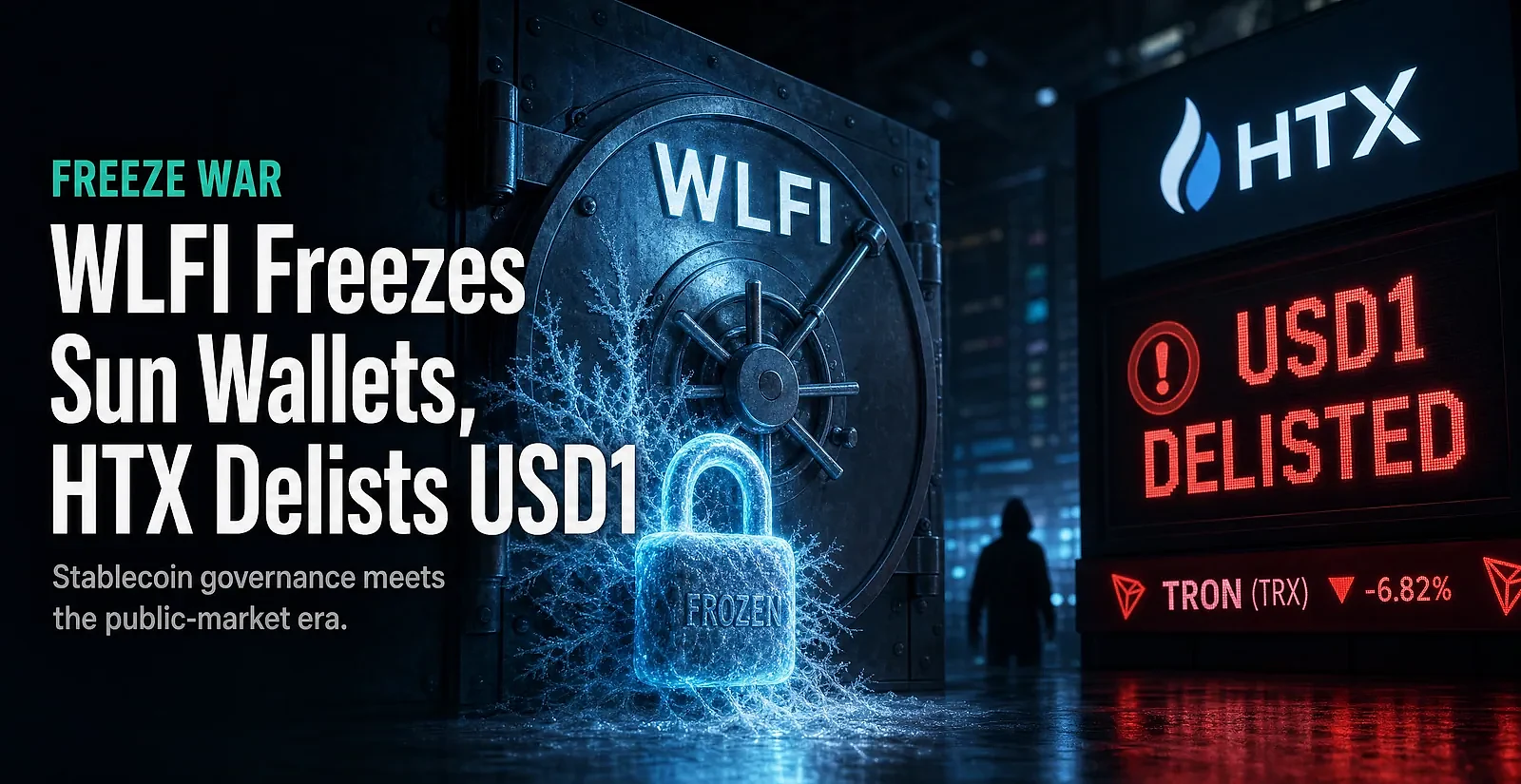
On June 7, 2026, HTX completed the delisting of USD1, the dollar-pegged stablecoin issued by World Liberty Financial (WLFI), converting all eligible user balances to Tether (USDT) at a 1:1 rate. The move ended a two-year commercial relationship that had once been a marquee partnership: USD1 originally launched first on HTX before expanding to other venues. What ended it was not a market failure but something more consequential for the entire stablecoin industry: a unilateral on-chain freeze, executed by the issuer against an exchange, with no prior notice and disputed legal grounds.
The Showdown: Two Principals, Two Public Mandates
Justin Sun, founder of the Tron blockchain and global adviser to HTX, is no longer simply a crypto entrepreneur. In July 2025, the former toy manufacturer SRM Entertainment completed a reverse merger and rebranded as Tron Inc. (TRON), listing on Nasdaq with Sun as strategic advisor and injecting $100 million in TRX tokens into the company's treasury [1]. The combined transaction was valued at up to $210 million. Tron Inc. stock traded near $1.84 as of early 2026, representing a market capitalization of roughly $517 million [2]. Every significant commercial fight Sun enters now moves a publicly traded share price. That reality reshaped how HTX responded to the freeze: loudly, legally, and in English.
On the other side stands WLFI, a crypto venture co-founded by members of the Trump family that launched USD1 in March 2025 [3]. The project lists Donald Trump, Donald Trump Jr., Eric Trump, Barron Trump, and Zach Witkoff among its advisers [4]. The Trump family receives 75% of net proceeds from WLFI token sales, plus a share of USD1 profits. USD1 is backed by US Treasuries and cash equivalents, carries a circulating supply of more than $4.6 billion, and ranks as one of the largest stablecoins globally [5]. That scale means WLFI's compliance decisions affect not just one exchange but the liquidity profile of an asset touching every major trading venue.
Both parties arrived at this confrontation with structural reasons to escalate.
Timeline of the Freeze and Delisting
The immediate trigger was a UK government sanctions action on May 26, 2026. The UK's Foreign, Commonwealth and Development Office designated Huobi Global S.A., a Panamanian entity, alleging it processed roughly $1.5 billion in illicit volume connected to the A7 payments network and Garantex, a heavily sanctioned Russian cryptocurrency exchange [6]. HTX immediately disputed any connection, with spokesperson Molly Fu stating publicly that the exchange operates independently from Huobi Global S.A. and that any frozen funds belong exclusively to ordinary retail buyers with no link to sanctioned actors.
WLFI's response to the UK designation was to invoke its on-chain administrative controls. The project posted on X that it "maintains risk-based sanctions compliance controls" in light of recent sanctions updates, without confirming or elaborating on which addresses had been frozen [4]. Within days, HTX reported the consequence.
Date — Event
April 2026 — Justin Sun sues WLFI, alleging tokens frozen without justification; WLFI counter-sues for defamation
May 26, 2026 — UK FCDO sanctions Huobi Global S.A. for alleged Russian financial evasion links, $1.5B illicit volume
June 5, 2026 — HTX halts WLFI/USDT, USD1/USDT, BTC/USD1, ETH/USD1 pairs at 13:00 UTC; cites WLFI freeze of HTX on-chain addresses
June 6, 2026 — HTX announces USD1 delisting effective June 7 at 11:00 UTC+8
June 7, 2026 — Delisting takes effect; forced 1:1 conversion of user USD1 holdings to USDT begins
HTX's June 5 statement used precise, accusatory language:
"The World Liberty Financial (WLFI) project team recently stated that it has unilaterally imposed a freeze on specific HTX on-chain addresses based on sanctions compliance reviews. As a result, the on-chain circulation of certain WLFI assets associated with these addresses has been restricted. HTX's addresses were frozen without sufficient prior communication, adequate contractual or legal grounds, transparent disclosure, or adherence to due process."
WLFI issued no detailed public rebuttal.
The IPO Era Stakes
The crypto industry entered a sustained public-market expansion in 2025 and 2026. Circle (CRCL) went public in 2025. Tron Inc. debuted on Nasdaq in July 2025 via the SRM Entertainment reverse merger [1]. Bullish and Kraken have pursued IPO timelines, with Kraken aiming for a Nasdaq listing in 2026. In this environment, every commercial conflict between major crypto entities carries equity-market implications.
For Sun and HTX, retaliating publicly served multiple audiences: HTX users, crypto media, and Nasdaq investors in Tron Inc. Passivity in the face of a unilateral freeze would have carried real reputational cost for a publicly traded entity.
For WLFI, exercising the freeze was also a public statement. A Trump family-connected stablecoin demonstrating it would enforce sanctions compliance against one of the world's largest crypto exchanges sends a signal to US regulators, international financial institutions, and the political environment around the GENIUS Act, the landmark stablecoin legislation signed into law by President Trump in July 2025 [7]. Showing capability is itself a form of regulatory compliance theater.
What "Sanctions Compliance" Actually Means Here
The factual core of WLFI's position rests on the UK designation of Huobi Global S.A. HTX has consistently argued that Huobi Global S.A. is a legally distinct entity from the current operating exchange. If that distinction holds, the sanctions basis for freezing HTX's on-chain addresses was at minimum highly contestable.
This creates a question regulators must eventually answer: when a stablecoin issuer invokes "sanctions compliance" to freeze a counterparty's wallets, what evidentiary standard applies? Traditional financial institution freezes follow an OFAC designation or court order. WLFI appears to have acted unilaterally based on an indirect sanctions nexus: a legacy entity name overlap with HTX. Whether that threshold satisfies any recognized legal standard remains disputed.
HTX's legal threat is not posturing. Sun filed a $276 million federal lawsuit against WLFI in April 2026, alleging frozen tokens and an undisclosed "blacklist" mechanism [8]. WLFI counter-sued for defamation. Both cases remain active across two US jurisdictions; the exchange-level freeze runs on a separate legal track.
Stablecoin Freeze Authority Under the GENIUS Act
The structural significance of this episode extends beyond the two parties. Every regulated stablecoin carries issuer-level freeze capabilities. The GENIUS Act, signed in July 2025, mandates that all permitted payment stablecoin issuers maintain "technical blocking, freezing, and rejecting capabilities" as part of their BSA/AML obligations [7]. Freeze power is a legal requirement, not an optional feature.
The practical implication: every exchange, custodian, and institutional treasury holding a regulated stablecoin carries counterparty risk relative to that issuer's compliance team. The freeze policies across major active issuers:
Issuer — Stablecoin — Freeze Capability — Notable Precedents
Tether — USDT — Yes, since 2017 — Multiple OFAC-linked freezes; over $1.7B frozen historically
Circle — USDC — Yes — Froze $75K+ in Tornado Cash-linked addresses (2022); BlackBridge freeze (2023)
Ripple — RLUSD — Yes — Built into token contract; limited public use to date
World Liberty Financial — USD1 — Yes — September 2025: 272 wallets frozen; June 2026: HTX exchange addresses frozen
What distinguishes the HTX case is the target. Tether and Circle have primarily frozen wallets linked to confirmed hacks, OFAC designations, or law enforcement requests. WLFI froze an active exchange's operational addresses based on a sanctions designation the exchange contests as inapplicable. Under the GENIUS Act, issuers must maintain an "effective economic sanctions compliance program" with wide discretion over its scope [7]. WLFI's June freeze was precisely that discretion exercised at scale.
Why This Won't Be the Last One
The HTX-USD1 dispute is a preview, not an anomaly. As stablecoin issuers grow to multi-billion-dollar circulating supplies, the commercial and legal disputes between issuers and their largest distribution partners will multiply. USD1's original launch on HTX now reads as ironic; the exchange that gave the stablecoin its first major trading venue became the first major venue to be frozen by it.
The precedent will shape how exchanges negotiate listing agreements for regulated stablecoins. What contractual rights does an exchange hold if its addresses are frozen? What evidentiary standard must an issuer meet before invoking freeze powers against an institutional counterparty? The GENIUS Act mandates freeze capability; it does not specify procedural guardrails for exercising it against a party that disputes the factual basis [7].
"WLFI's willingness to lock wallets via smart contract functions is not unprecedented, though deploying the mechanism against an institutional exchange marks a significant escalation in its compliance strategy. The question is no longer whether stablecoin issuers have this power. It is what legal and contractual guardrails govern when and how they use it." [6]
For Sun, the outcome is a delisted stablecoin and active litigation. For WLFI, it is a demonstration of enforcement capability that cuts both ways: issuers can signal compliance credibility to regulators while triggering commercial blowback from counterparties denied due process. Every regulated stablecoin is, at the infrastructure level, a permissioned asset. The HTX freeze made that visible at institutional scale.
USD1 survived a more diffuse stress test in February 2026, when a coordinated attack briefly depressed its peg to $0.994 before recovery. Surviving that while simultaneously triggering a major exchange delisting reveals a different vulnerability: not peg stability, but distribution reach. As the crypto IPO wave continues and more stablecoin issuers operate under public-market scrutiny, every compliance decision carries an equity-market price tag.
References
[1] CNBC, "Justin Sun's Tron goes public, reverse merger led by Trump-linked bank," June 16, 2025. https://www.cnbc.com/2025/06/16/justin-suns-tron-goes-public-reverse-merger-led-by-trump-linked-bank.html
[2] BeInCrypto, "Justin Sun Pitches TRON Inc as Cheaper Circle With Microstrategy-style TRX Treasury Play," March 18, 2026. https://beincrypto.com/tron-inc-microstrategy-trx-treasury-play/
[3] Stablecoin Insider, "Trump's World Liberty Financial Is on Track to Earn $150 Million from Its USD1 Stablecoin in 2026," June 8, 2026. https://stablecoininsider.org/trumps-world-liberty-financial-is-on-track-to-earn-150-million-from-its-usd1-stablecoin-in-2026/
[4] crypto.news, "Justin Sun's HTX drops USD1 as WLFI freeze fight grows," June 8, 2026. https://crypto.news/justin-suns-htx-drops-usd1-as-wlfi-freeze-fight-grows/
[5] CoinMarketCap, "World Liberty Financial USD (USD1) statistics," accessed June 8, 2026. https://coinmarketcap.com/currencies/usd1/
[6] CryptoRank, "Trump's family crypto feud spills into customer accounts after wallet freeze," June 8, 2026. https://cryptorank.io/news/feed/9b106-trumps-family-crypto-feud-spills-into-customer-accounts-after-wallet-freeze
[7] Paul, Weiss, "GENIUS Act Ushers in Comprehensive Federal Regulation of Payment Stablecoins," July 28, 2025. https://www.paulweiss.com/insights/client-memos/genius-act-ushers-in-comprehensive-federal-regulation-of-payment-stablecoins
[8] BingX News, "HTX removes WLFI's USD1 after June 8, 2026 freeze, as $276M lawsuit expands," June 8, 2026. https://bingx.com/ar/news/post/htx-removes-wlfi-s-usd-after-june-freeze-as-m-lawsuit-expands