Gulf Energy Production Collapses as IDF Strikes Iranian Oil Refineries and Brent Surges Past $114
IDF airstrikes hit Iranian oil refineries for the first time on March 7 as Gulf energy production collapsed across Iraq, Qatar, Saudi Arabia, and Kuwait, sending Brent crude to $114.93 per barrel on March 9, the highest level since 2022.
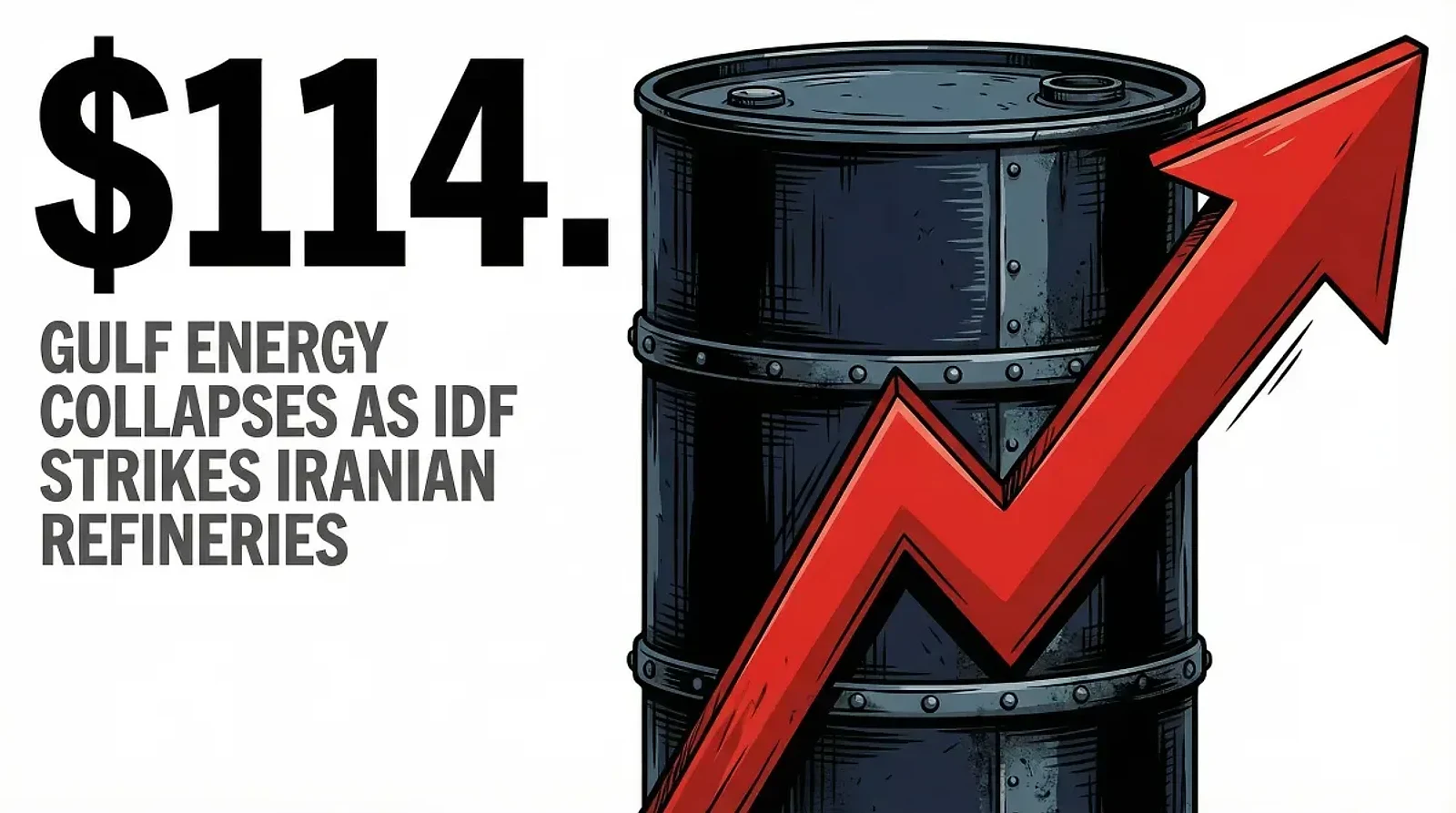
The Israel Defense Forces struck Iranian oil production and storage facilities for the first time on March 7, 2026, hitting the Tondgouyan Oil Refinery in Tehran Province and the Shahran Oil Refinery in Tehran City as Gulf energy production collapsed across multiple countries. Brent crude surged to $114.93 per barrel on March 9, its highest level since 2022, while WTI traded between $107.59 and $114.86, as the market priced in the loss of millions of barrels of daily production [1][2][3].
The strikes marked a deliberate escalation in the combined U.S.-Israeli air campaign that began on February 28. The IDF stated it had struck "oil production and storage facilities that directly supported Iran's military industrial complex," targeting not only the two refineries but also oil storage facilities in Karaj, Alborz Province and central Tehran City, both first-time targets [1].
The March 7 Strikes
According to the Critical Threats Project at the American Enterprise Institute, the Tondgouyan refinery is one of Iran's largest, while the Shahran facility previously held 11 storage tanks containing three days of fuel supply for the capital. Both had been struck during the brief "12-Day War" in June 2025 and were still operating at reduced capacity when hit again. The IDF reported striking over 300 targets in Iran over the preceding two days, while U.S. Central Command stated it had hit more than 3,000 targets since the campaign's start on February 28 [1].
"The combined force expanded its airstrike campaign to include Iranian oil production and storage facilities for the first time on March 7." [1]
Iranian authorities confirmed four people were killed in the strikes on oil depots and a petroleum transfer terminal. Mohammad Bagher Qalibaf, Speaker of Iran's parliament, warned that the war's impact on the country's oil industry would "spiral" [1][4].
Al Jazeera reported on March 8 that "the attacks on Saturday ignited significant fires as they struck four oil storage sites and a facility for oil production transfer in Tehran and the Alborz province" [4].
Gulf Production Shutdowns
The oil strikes compounded an energy crisis that had been building since the conflict began. Across the Persian Gulf, production shutdowns reached staggering levels as Iranian drone and missile attacks on neighboring states made export operations impossible.
Country — Facility/Sector — Impact — Cause
Iraq — Three main southern oilfields — Output fell 70%, from 4.3M b/d to 1.3M b/d — Storage tanks filling; tankers unable to export
Qatar — Ras Laffan LNG (world's largest) — Halted; force majeure declared — Iranian drone attacks
Saudi Arabia — Ras Tanura refinery and export terminal — 550,000 b/d shut; facility closed — Iranian drone strike and fire
Kuwait — Oil production and refinery output — "Precautionary cuts" (unspecified) — Iranian Hormuz threats
UAE — Offshore production — "Carefully managing"; onshore continues — Storage constraints
Kurdistan (Iraq) — Gulf Keystone and Shamaran — 110,000 b/d shut — Iranian drone strikes on U.S. installations in Erbil
Iran — Tondgouyan, Shahran refineries; Karaj storage — Major damage; Tehran fuel supply disrupted — IDF airstrikes (March 7)
Rystad Energy estimated that between 7 and 11 million barrels per day were temporarily missing from the market. Citi analysts calculated the market was losing 7 to 11 million barrels of crude daily along with 4 to 5 million barrels of refined products [5][8]. Vortexa data cited by the Wall Street Journal showed approximately 16 million barrels of crude stranded in the Gulf, while Kpler counted 55 fully loaded VLCCs trapped in the Persian Gulf as of March 3, an increase of 18 ships since February 28 [5][8].
Oil Price Timeline
The speed of the price surge has been historic. Brent crude sat at approximately $69 per barrel on February 28, the day the campaign began. Eleven days later, it traded above $114.
Date — Brent (USD/bbl) — WTI (USD/bbl) — Key Event
Feb 28 — ~$69 — ~$67 — U.S.-Israel campaign begins
Mar 1 — $79.41 (+9%) — $72.74 (+8.4%) — Strait of Hormuz threatened
Mar 3 — $81.40 (+4.7%) — $74.66 — Qatar LNG halt; Saudi Ras Tanura fire
Mar 6 — $92.69 — $90.90 — WTI +36% weekly (record since 1983)
Mar 7 — ~$93 — ~$91 — IDF strikes Iranian oil facilities
Mar 8 — $107.48 (+16.0%) — $108.58 (+19.5%) — First time above $100 since 2022
Mar 9 — $114.93 (+24.0%) — $107.59 to $114.86 — Highest since 2022
The weekly gain for WTI through March 6 of 36% was the largest since records began in 1983. Brent's weekly gain of 27% was the largest since 1991, during the first Gulf War [5][8].
$150 Warning
Qatar Energy Minister Saad al-Kaabi delivered the most sobering assessment of any Gulf official in a Financial Times interview reported around March 6-7. He warned that oil could reach $150 per barrel if the conflict persists and said it would take "weeks to months" to return to normal production even if hostilities ended immediately [6].
"If this continues for few weeks GDP growth around the world will be impacted. Everyone's energy prices will increase. There will be shortages of certain products, leading to a chain reaction in factories that cannot supply." [6]
Kaabi added that all Gulf producers would halt operations "within days" if tankers could not pass through the Strait of Hormuz, which normally handles 15 to 20 million barrels per day, roughly 20% of global oil supply [6][7].
Jorge Leon of Rystad Energy told the BBC: "We are on the brink of determining whether this is a brief energy crisis with limited consequences, or the onset of a significant economic and energy crisis" [6]. Barclays analyst Amarpreet Singh warned that Brent could reach $120 if conditions continued deteriorating [8].
On the U.S. side, gasoline prices had already climbed to $3.45 per gallon, up 47 cents from the prior week, while diesel reached $4.60, up 83 cents. U.S. Energy Secretary Chris Wright told CNN on March 9 that "in the worst case, this is a weeks, this is not a months thing," and predicted gas prices would return below $3 "before too long" [2][3]. S&P 500 futures fell 1.6%, Dow futures dropped 1.8%, and Nasdaq futures declined 1.5% as markets opened to the news [3].
The maritime insurance market has already responded. Gard, Skuld, NorthStandard, the London P&I Club, and the American Club collectively cancelled war risk coverage for tankers entering the Strait of Hormuz from March 5, while S&P Global Platts suspended price assessments for most Middle Eastern crude, refined products, and LNG [5].
References
[1] Critical Threats Project/ISW, Iran Update Evening Special Edition, March 7, 2026 - https://www.criticalthreats.org/analysis/iran-update-evening-special-edition-march-7-2026
[2] AP/ABC7, March 9, 2026 - https://abc7ny.com/post/crude-oil-prices-surpass-100-barrel-iran-war-impedes-production-shipping/18694128/
[3] US News/AP, March 9, 2026 - https://www.usnews.com/news/business/articles/2026-03-08/crude-oil-prices-surpass-100-a-barrel-as-the-iran-war-impedes-production-and-shipping
[4] Al Jazeera, March 8, 2026 - https://www.aljazeera.com/news/2026/3/8/israel-strikes-irans-oil-facilities-for-first-time-as-war-enters-ninth-day
[5] Reuters, March 3, 2026 - https://www.reuters.com/business/energy/global-energy-costs-soar-iran-crisis-disrupts-shipping-oil-gas-production-2026-03-03/
[6] BBC, March 6, 2026 - https://www.bbc.com/news/articles/cy031ylgepro
[7] Seeking Alpha, March 8, 2026 - https://seekingalpha.com/news/4562067-war-will-force-gulf-producers-to-stop-energy-exports-within-days-qatar-energy-minister-says
[8] Wall Street Journal, March 6-7, 2026 - https://www.wsj.com/finance/commodities-futures/oil-futures-fall-after-bessent-unveils-stopgap-measure-for-india-2657c96b