Global Regulators Tighten Grip on Stablecoins as GENIUS Act Takes Shape
From the OCC's GENIUS Act rulebook to Bank of Korea AML limits and the Bank of England's singleness-of-money warning, global regulators are converging on stablecoin oversight frameworks that treat digital money issuance like banking.
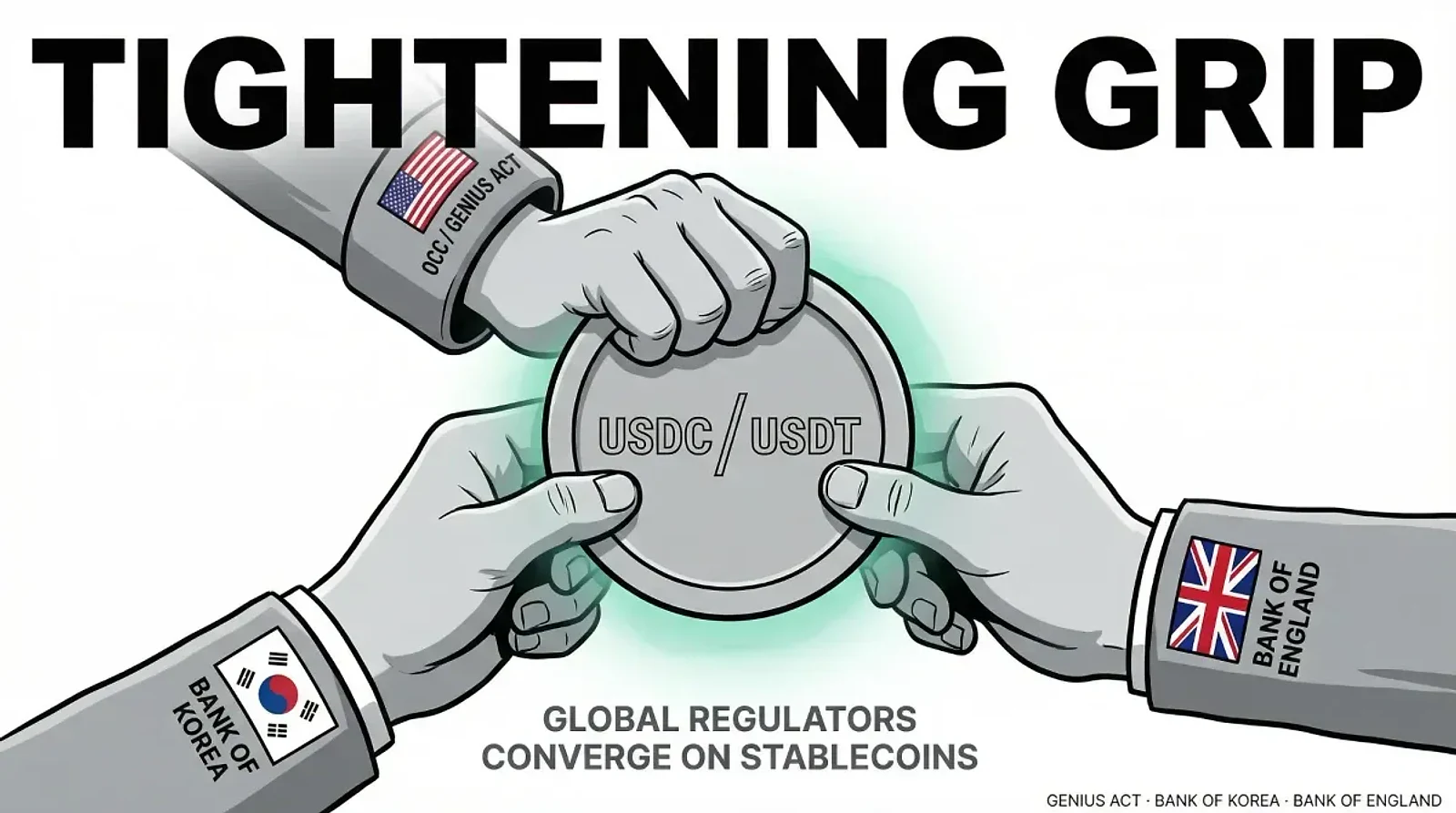
Global stablecoin oversight crossed a threshold in February 2026 as the Office of the Comptroller of the Currency (OCC) published its first comprehensive implementing rulebook for the GENIUS Act, converting a landmark July 2025 statute into enforceable supervisory standards. From Seoul to London to Basel, central banks and financial watchdogs are converging on a common conclusion: privately issued digital money demands the same institutional scrutiny as the banking system it threatens to bypass.
The OCC Rulebook: Banking Rules for the Digital Dollar
On February 25, 2026, the OCC issued a Notice of Proposed Rulemaking (NPRM) establishing a dedicated regulatory section, 12 CFR Part 15, for entities it classifies as Permitted Payment Stablecoin Issuers (PPSIs) [1]. The proposal operationalises the GENIUS Act, which President Trump signed into law on July 18, 2025 as the first federal statute to directly regulate digital assets in the United States. The Act defines a "payment stablecoin" as a digital asset designed for use as a means of payment, backed by a fixed amount of monetary value, and issued exclusively by an authorised entity. The OCC's rulebook goes further, imposing minimum capital thresholds, liquidity buffers beyond token redemption obligations, formal governance structures, and explicit third-party risk management requirements on prospective issuers. In short, launching a stablecoin will now resemble applying for a bank charter rather than shipping a software product [1].
The reserve framework is central to the proposal. All PPSIs must maintain 1:1 reserve backing in high-quality liquid assets, a list that is strictly enumerated to include cash at the Federal Reserve, short-term U.S. Treasury securities, qualifying repurchase agreements, and certain money market funds [1]. Riskier instruments such as bitcoin, gold, and secured loans are explicitly excluded from the eligible reserve list, a direct response to concerns raised by critics about the deteriorating quality of Tether's USDT collateral. The OCC further proposes that at least 10% of reserves be held as demand deposits at a Federal Reserve Bank, with a weighted average maturity cap of 20 days for the broader portfolio [1]. A 60-day public comment period is open, covering more than 200 discrete questions, making stakeholder engagement unusually consequential for the final calibration of the rule.
"Stablecoin issuance is being prudentialised, not lightly regulated. The proposal places payment stablecoins squarely within a bank-like supervisory framework emphasising reserve integrity, capital adequacy, liquidity discipline, and governance." [Gibson Dunn analysis of the OCC NPRM, March 2026]
South Korea: Banks Only, AML First
Across the Pacific, the Bank of Korea (BOK) is pushing a structurally conservative position. In a formal report submitted to the National Assembly's Strategy and Finance Committee on February 23, 2026, the central bank reiterated its recommendation that won-denominated stablecoin issuance be restricted exclusively to licensed commercial banks [2]. The BOK's position rests on three pillars: banks already operate under strict capital adequacy requirements and anti-money laundering (AML) frameworks; non-bank issuers would introduce oversight complexity and systemic vulnerability; and privately issued stablecoins could enable users to convert won into dollar-pegged assets, bypassing South Korea's capital flow management measures [2]. The urgency of the BOK's caution was sharpened by an operational incident this month at crypto exchange Bithumb, which erroneously transferred approximately $40 billion worth of so-called "ghost" Bitcoin to clients.
BOK Governor Rhee Chang-yong has stated that "currency operates on trust, not technology," citing the 2022 Terra/Luna collapse and USDC's temporary de-pegging as evidence that institutional backing is non-negotiable. The central bank has also proposed a bank-centred consortium model requiring banks to hold at least a 51% equity stake in any stablecoin-issuing entity. The Financial Services Commission (FSC) has pushed back, arguing that such rigidity could stifle fintech participation, leaving South Korea's Digital Asset Basic Act delayed well into 2026 [2].
Bank of England: The Singleness Problem
In the United Kingdom, the Bank of England published a working paper on February 27, 2026, examining what it calls the risk to the "singleness of money" posed by the proliferation of private digital currencies [3]. Author Benjamin Hemingway models the conditions under which monetary cohesion could break down if stablecoins issued by competing private entities fail to maintain a reliable 1:1 exchange rate among themselves and against central bank money. The paper concludes that singleness is "an equilibrium outcome shaped by institutional design, market structure, and policy choices," not a guaranteed property of any particular technology architecture. Without robust convertibility guarantees and regulatory oversight, fragmentation of the money supply becomes a material risk, one that the BoE regards as incompatible with financial stability.
Regulatory Jurisdiction — Key Action (Feb 2026) — Core Mechanism — Status
United States (OCC) — NPRM under GENIUS Act — 1:1 reserves, capital, 120-day licensing — Comment period open
South Korea (BOK) — National Assembly report — Bank-only issuance, AML-first — Legislation delayed
United Kingdom (BoE) — Working paper published — Singleness-of-money risk modelling — Policy formation stage
Bank for International Settlements — SEACEN Policy Summit speech — USD stablecoin systemic risk framing — Advisory
BIS and the Dollar Stablecoin Question
The Bank for International Settlements (BIS) added a macro-systemic dimension at the SEACEN Policy Summit in Kuala Lumpur on February 5, 2026, where Bank Negara Malaysia Governor Abdul Rasheed Ghaffour warned that USD-backed stablecoins, if widely adopted, could introduce run risks, contribute to currency substitution in emerging economies, and fragment payment systems unless interoperability and supervision keep pace [4]. Citing IMF monitoring work on the international monetary system, the speech highlighted that the international use of crypto assets, particularly dollar-pegged stablecoins, has been increasing while cross-border CBDC use remains experimental. For Asia-Pacific economies already navigating dollar-liquidity stress and geoeconomic fragmentation, the rise of privately issued digital dollars presents a structural policy challenge that no single jurisdiction can resolve alone.
The Hougan-Dimon Divide
The debate over the appropriate regulatory model broke into public view on March 2, 2026, when Matt Hougan, CIO of Bitwise Asset Management, sharply criticised remarks by JPMorgan CEO Jamie Dimon on CNBC [5]. Dimon had argued that stablecoins paying rewards on balances are functionally equivalent to banks and should be regulated accordingly. Hougan countered that stablecoin issuers seek to operate as fully reserved money market-style products holding exclusively short-term Treasuries, not as fractional reserve banks engaged in risky lending.
"Stablecoin issuers are not aiming to operate like fractional reserve banks that engage in risky lending and require heavy oversight. They seek to function as fully reserved money market products, holding exclusively short-term U.S. Treasuries." Matt Hougan, Bitwise Asset Management CIO, March 2, 2026 [5]
The distinction matters enormously for market structure. USDT, with a market capitalisation hovering around $184 billion, and USDC, its closest competitor, together account for roughly 85% of the stablecoin market [1]. Whether regulators treat these instruments as bank-like deposits or as payment utilities will determine the economics of stablecoin issuance, the scope of permissible reserve assets, and whether the GENIUS Act's prohibition on yield payments can be circumvented through third-party arrangements. The OCC's proposal directly targets that last point, introducing a rebuttable presumption that affiliate arrangements replicating yield economics are impermissible [1].
Convergence Without Coordination
What is striking about the February 2026 regulatory surge is its simultaneity without formal coordination. The OCC, the BOK, the BoE, and the BIS are each arriving independently at overlapping conclusions: stablecoins require institutional-grade reserves, governance commensurate with systemic importance, and explicit protection of the monetary transmission mechanism. The absence of a global standard, however, creates arbitrage risk. The GENIUS Act's foreign issuer provisions, which require comparable home-country regulation for non-U.S. stablecoins to access U.S. markets, represent one attempt to export the standard, but the determination of what counts as "comparable" rests with the U.S. Treasury Department and remains undefined [1]. For global issuers and institutional adopters, the emerging regime is a patchwork of overlapping supervisory jurisdictions, each with its own reserve calibration, AML requirements, and licensing timeline.
References
- [1] Gibson Dunn, "OCC Proposes Comprehensive Stablecoin Regulatory Framework to Implement the GENIUS Act," March 2, 2026: https://www.gibsondunn.com/occ-proposes-comprehensive-stablecoin-regulatory-framework-to-implement-the-genius-act/
- [2] Bloomberg, "BOK Urges Limiting Stablecoin Issuers on Money Laundering Risks," February 23, 2026: https://www.bloomberg.com/news/articles/2026-02-23/bok-urges-limiting-stablecoin-issuers-on-money-laundering-risks
- [3] Central Banking, "Stablecoins Pose Risks to Singleness of Money, BoE Study," March 2, 2026: https://www.centralbanking.com/fintech/7975269/stablecoins-pose-risks-to-singleness-of-money-boe-study
- [4] BIS / Bank Negara Malaysia, "Abdul Rasheed Ghaffour: The Future of International Monetary System," SEACEN Policy Summit, February 23, 2026: https://www.bis.org/review/r260223d.htm
- [5] Blockchain.news, "Matt Hougan Criticizes Jamie Dimon's Argument on Stablecoin Regulation," February 3, 2026: https://blockchain.news/flashnews/matt-hougan-criticizes-jamie-dimon-s-argument-on-stablecoin-regulation