Gibson Dunn Releases Comprehensive Cross-Border Guide to Global Stablecoin Regulation
The law firm's new guide maps stablecoin licensing, reserve, and custody rules across six jurisdictions, highlighting critical divergences that shape where issuers domicile and how they structure reserves.
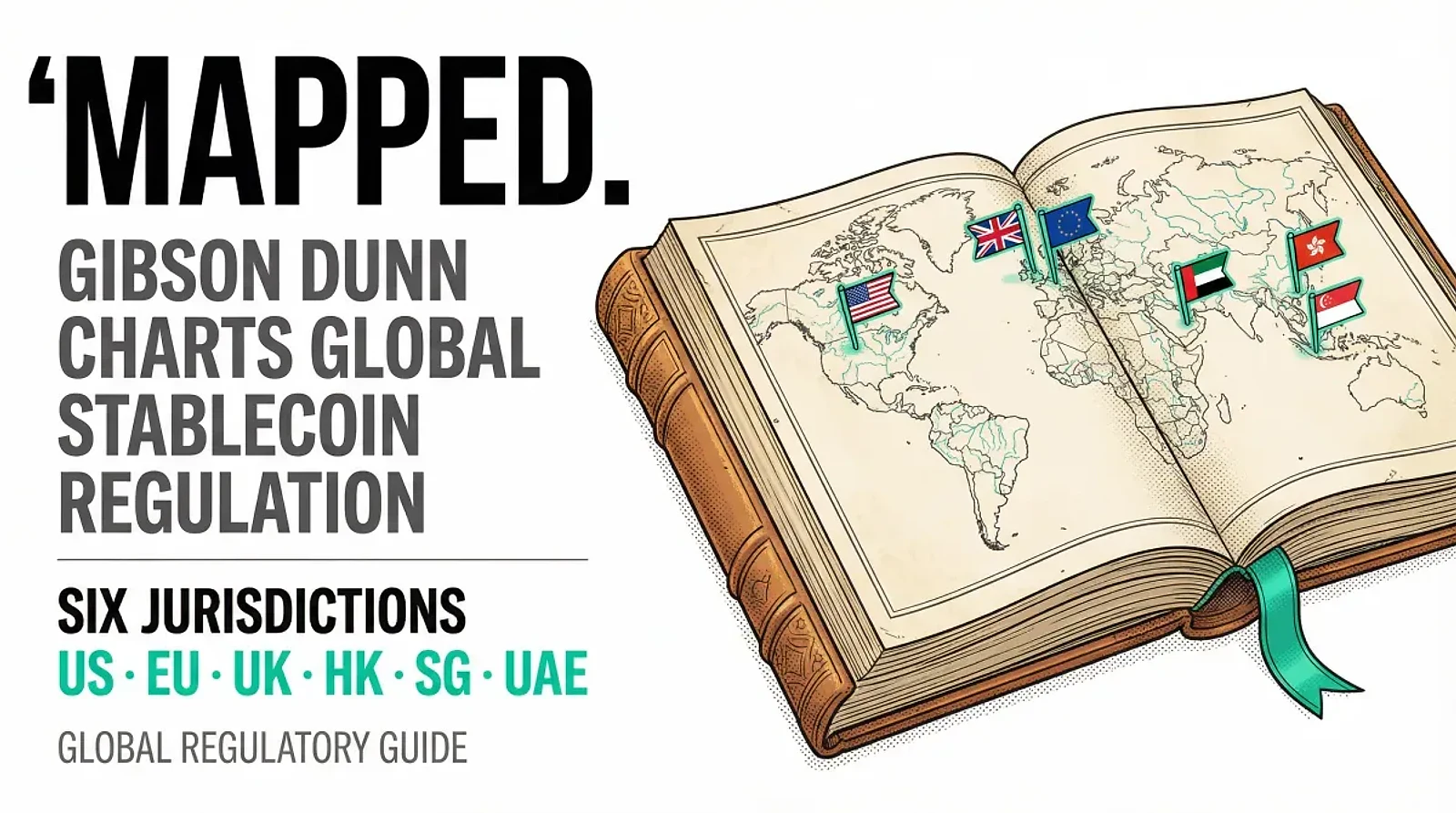
International law firm Gibson Dunn & Crutcher LLP on March 13, 2026 published a sweeping cross-border regulatory guide titled "Global Stablecoin Rules in Focus: A Cross-Border Guide to the New Era of Stablecoin Regulation," covering six major jurisdictions and providing the most detailed comparative analysis yet of the regulatory frameworks shaping the global stablecoin market [1][2]. The guide arrives at a moment when issuers, exchanges, and institutional users face a patchwork of national rules that diverge on licensing, reserves, custody, and foreign issuer access.
Six Jurisdictions, One Fragmented Landscape
The guide covers the United States (GENIUS Act), the European Union (Markets in Crypto-Assets Regulation, or MiCA), the United Kingdom, Hong Kong, Singapore, and the United Arab Emirates [1]. Each jurisdiction mandates 1:1 reserve backing, but the similarities thin rapidly from there. Reserve composition rules, disclosure frequency, custody structures, and the treatment of foreign issuers vary materially across borders.
Gibson Dunn's authors, a nine-lawyer team spanning New York, London, Singapore, Hong Kong, Dubai, and Washington, frame the stakes plainly:
"Stablecoins have moved from experimental rails to core market infrastructure, prompting regulators around the world to define who may issue them, how reserves must be held, and what rights users have upon redemption."
Jurisdiction — Framework — Reserve Ratio — Reserve Assets — Yield to Holders — Audit/Disclosure
United States — GENIUS Act (signed July 2025) — 1:1 — USD, deposits, T-bills (93 days or less), approved liquid assets — Prohibited — Monthly public; CEO/CFO certified; annual audit
European Union — MiCA (in force mid-2024) — 1:1 — Highly liquid instruments; min. 30% EU bank deposits — Prohibited — White paper; 6-month audit for significant EMTs
United Kingdom — FSMA 2023 (transitional) — 1:1 — Secure, liquid, low-risk; min. 5% UK bank deposits — Prohibited (proposed) — Quarterly disclosure; annual audit
Hong Kong — Stablecoins Ordinance (Aug 2025) — 1:1 + over-collateralization — Bank deposits (3 months or less); govt debt (1 year or less); overnight repos — No explicit prohibition — Weekly attestations to HKMA; white paper required
Singapore — Payment Services Act (amendments pending) — 1:1 (marked daily) — Cash/equivalents; govt debt (3 months or less residual maturity) — Not permitted — Monthly public attestation; annual audit
UAE — CBUAE PTSR; VARA; FSRA; DFSA — 1:1 — High-quality liquid reserves — Prohibited — Varies by regulator; VARA requires monthly audit
The U.S. GENIUS Act: Three Paths, One Prohibition
Under the GENIUS Act, signed on July 18, 2025, domestic issuers must choose among three pathways: operating as a subsidiary of an insured depository institution, obtaining a federal charter from the OCC, or securing state approval [1]. Foreign issuers may register with the OCC beginning July 18, 2028, provided their home jurisdiction receives a "comparable" determination from the Treasury Secretary. Reserves must be held in USD, deposits, short-term Treasuries with 93 days or fewer remaining maturity, and other approved liquid assets. Rehypothecation is prohibited. Monthly public reporting on reserve composition, certified by the CEO and CFO, is mandatory.
The guide flags that reserve localization requirements for foreign issuers, which demand U.S.-based reserves sufficient for domestic customer liquidity, represent a significant operational constraint [1][2].
MiCA's Passport and Its Dollar Problem
The EU's MiCA framework, fully in force since mid-2024, offers a powerful competitive advantage: a single regulatory passport valid across all member states [1]. Only EU-authorized credit institutions or electronic money institutions may issue e-money tokens. At least 30% of received funds must be deposited with EU credit institutions.
Yet the guide identifies a structural tension. MiCA's "multiple issuance" structures allow non-EU issuers to circulate dollar-denominated stablecoins backed by non-EU reserves, a loophole that potentially undermines the euro's role in European payments [1]. The European Commission is considering granting the European Banking Authority more direct oversight over "significant CASPs" and tighter controls on delegation to third countries.
The UK's Missing Exemption
The United Kingdom is moving toward a comprehensive framework under the Financial Services and Markets Act 2023, with FCA authorization applications expected between September 30, 2026 and February 28, 2027, and the full regime anticipated to commence in October 2027 [1]. Reserve rules would require a minimum 5% of reserves in on-demand UK bank deposits, with assets held in statutory trust.
Gibson Dunn flags a notable gap: the Cryptoassets Regulation omits a clear "overseas persons exemption," meaning foreign firms issuing stablecoins into the UK may avoid full FCA regulation while domestic issuers shoulder strict prudential and disclosure obligations [1]. The resulting uneven playing field could discourage UK domiciliation.
Hong Kong and Singapore: Divergent Signals
Hong Kong's Stablecoins Ordinance, effective since August 2025, stands out for its strict localization requirements and its expectation of over-collateralization above the 1:1 floor [1]. Senior management must reside in Hong Kong. Only HKMA-licensed stablecoins may be offered to retail investors.
Singapore's approach under the Payment Services Act applies only to single-currency stablecoins referencing a G10 currency or the Singapore dollar [1]. Issuers meeting all MAS requirements can market their products as "MAS-regulated stablecoins," a quality-signaling mechanism unique among the jurisdictions surveyed.
The UAE's Layered Architecture
The UAE presents the most complex regulatory map, with federal rules under the Central Bank (CBUAE) coexisting alongside free zone regulators VARA (Dubai), FSRA (Abu Dhabi Global Market), and DFSA (Dubai International Financial Centre) [1]. The CBUAE prohibits onshore issuance of foreign-denominated stablecoins entirely; only AED-pegged tokens may be issued domestically, with AE Coin launching as the first licensed example in late 2024. Foreign-denominated stablecoins such as USDC and USDT require CBUAE registration merely for distribution.
Cross-Border Themes
The guide identifies several structural themes that will shape the global stablecoin market. Jurisdictional divergence, despite common principles around payment stability and consumer protection, creates concrete business decisions around domiciliation, reserve structuring, and distribution strategy [1]. The definition of "comparable" under the GENIUS Act's foreign issuer pathway remains unresolved and will determine how easily non-U.S. issuers access the American market. And the tension between monetary sovereignty concerns and the dominance of dollar-denominated stablecoins runs through nearly every framework examined.
"Across leading jurisdictions, common policy aims, payment stability and consumer protection, coexist with divergent approaches to licensing, prudential standards, disclosures, custody, and market conduct."
For compliance teams and general counsel at stablecoin issuers, exchanges, and institutional users, the Gibson Dunn guide provides the most comprehensive jurisdictional comparison available to date, and a roadmap for the regulatory arbitrage calculations that will define the industry's next phase.
References
[1] Gibson Dunn Client Alert, "Global Stablecoin Rules in Focus: A Cross-Border Guide to the New Era of Stablecoin Regulation," March 13, 2026. https://www.gibsondunn.com/global-stablecoin-rules-in-focus-a-cross-border-guide-to-the-new-era-of-stablecoin-regulation/ [2] Gibson Dunn PDF Guide, March 2026. https://www.gibsondunn.com/wp-content/uploads/2026/03/global-stablecoin-rules-in-focus-a-cross-border-guide-to-the-new-era-of-stablecoins.pdf [3] Gibson Dunn Appendix 1 (Country Comparison Table), March 13, 2026. https://www.gibsondunn.com/wp-content/uploads/2026/03/Fintech-and-Digital-Asssets-Global-Stablecoin-Rules-in-Focus-03.13.26_Appendix1.pdf