GENIUS Act Proposed Rules Land in Federal Register with July 18, 2028 Enforcement Date
Treasury's proposed GENIUS Act rule sets July 18, 2028 as the U.S. provider-level deadline for offering or selling qualifying payment stablecoins, while defining the foreign issuer route.
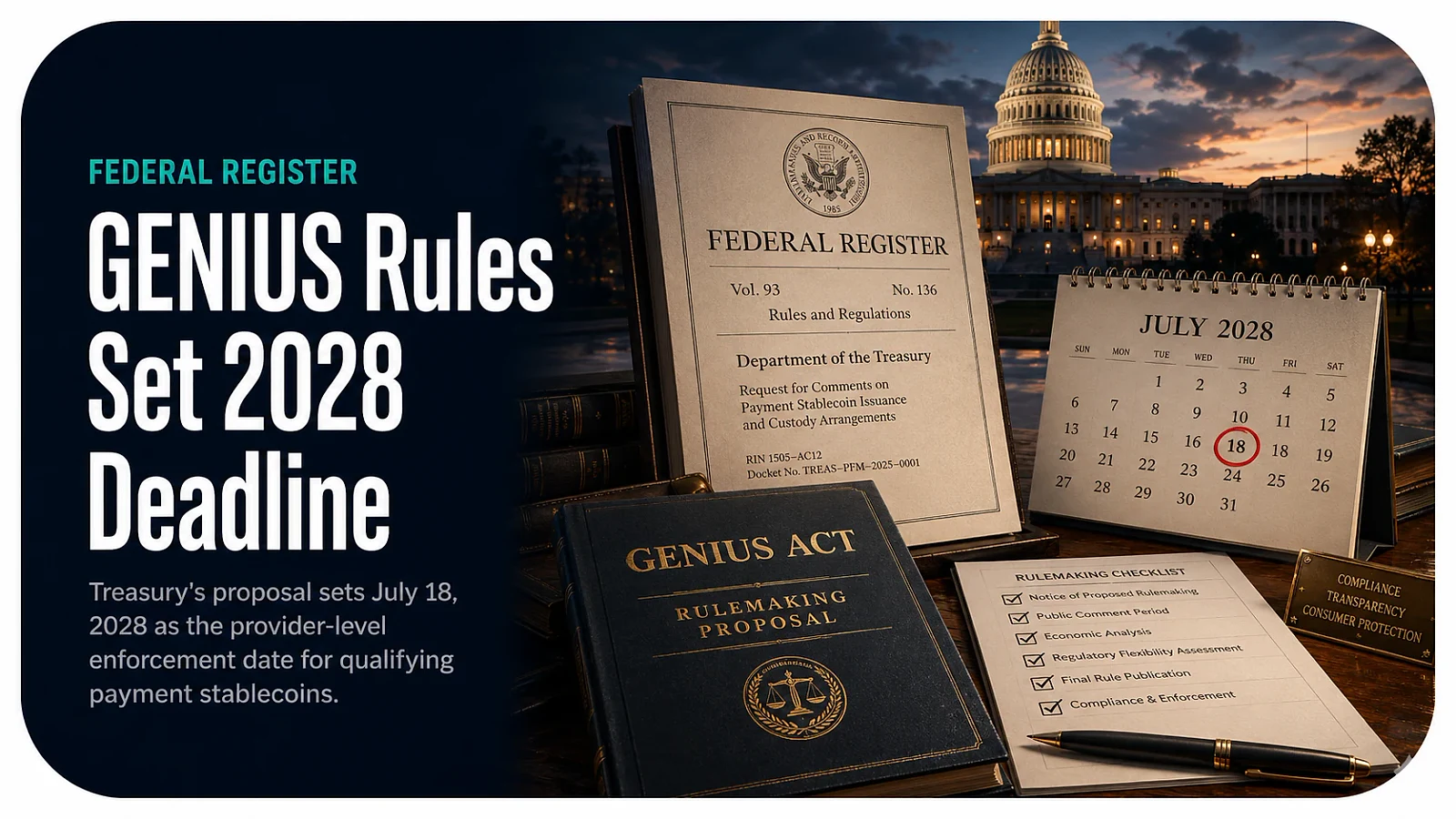
The Treasury Department's proposed GENIUS Act regulations reached the Federal Register on August 18, putting a concrete date on the market-access test that exchanges, wallets and issuers have been awaiting. The proposed 12 CFR part 1523 says digital asset service providers cannot offer or sell non-qualifying payment stablecoins to people located in the United States beginning July 18, 2028, three years after the law was enacted.[1][3]
The publication, 91 FR 53368-53391, arrives one month after the July 18, 2026 statutory deadline that NewCurrency highlighted in B30-16. The delay matters less than the calendar Treasury has now made explicit: the Act is expected to take effect on January 18, 2027, while the broad provider-level offer-and-sale restriction starts 18 months later. Public comments on the proposal are due October 19.[1]
A three-year market-access deadline
The most important sentence sits in proposed § 1523.3(a). It applies to a digital asset service provider, the Act's category for businesses that exchange, transfer, custody or participate in financial services around digital assets for compensation in the United States.[3]
“Beginning on July 18, 2028 ... it shall be unlawful for a digital asset service provider to offer or sell a payment stablecoin to a person located in the United States unless the payment stablecoin is: (1) Issued by a permitted payment stablecoin issuer; or (2) Issued by a foreign payment stablecoin issuer that meets the criteria set out in section 18(a) of the Act.”[1]
That is a market-structure deadline, not a blanket grace period for every issuer. Proposed § 1523.2(a) would make it unlawful to issue a payment stablecoin in the United States unless the issuer is permitted or meets the foreign-issuer exception, once the Act is effective. The 2028 date specifically governs the later prohibition on a service provider offering or selling a payment stablecoin to a person in the United States.[1][2]
Key provision — Proposed treatment — Commercial consequence
Issuance definition, § 1523.2(b) — Issuance is in the United States if the issuer is located there or issues to a person located there. — Offshore structure alone does not remove a U.S. issuance.
Location test — An individual is generally located in the United States when physically present; a U.S. entity is located there if organized under U.S. or state law or principally based there. — Providers need location controls rather than a nationality-only screen.
Provider enforcement, § 1523.3(a) — Offer and sale restriction begins July 18, 2028. — Listing and distribution policies face a firm three-year statutory backstop.
Foreign issuer path, section 18(a) — Comparable foreign supervision, OCC registration, U.S.-institution liquidity reserves for U.S. customers unless reciprocity permits otherwise, and no disqualifying sanctions or primary-money-laundering-concern jurisdiction. — A qualifying non-U.S. issuer can preserve U.S. access.
The definition that reaches beyond incorporation papers
Treasury's proposed rule is designed to decide where issuance occurs, not merely where an issuer has incorporated. Under § 1523.2(b), a person issues in the United States if it is located in the country or if it issues to someone located here. The draft definition of "issue" is the first transfer by the issuer that gives someone else the right to use, transfer, convert, redeem or repurchase the coin, including an indirect transfer or account credit.[1]
The location test is physical for individuals, with a temporary visit by a nonresident excluded. For companies, incorporation and principal place of business both matter. Treasury would also deem certain non-U.S. issuance outside the country when the issuer uses reasonable location controls and avoids U.S.-targeted solicitation.[1]
That gives exchange compliance teams a more operational assignment. The proposal expressly identifies direct solicitation, U.S.-targeted advertising, a willingness to sell after an unsolicited U.S. inquiry, advice on evading IP checks, and sales contracts as examples of offer-or-sale activity. Conversely, a provider can be deemed not to offer or sell in the United States if it reasonably believes the customer is outside the country, uses appropriate controls and does not target the market.[1]
Foreign route remains open, but it is not passive
The foreign-issuer alternative is the consequential relief valve. Section 18(a) does not simply grandfather offshore dollar tokens. It requires the Treasury Secretary to find that the issuer's home regime is comparable, requires registration with the Office of the Comptroller of the Currency, and generally requires U.S.-institution reserves sufficient for U.S. customer liquidity. The statute also excludes issuers in comprehensively sanctioned countries or jurisdictions the Secretary has identified as primary money-laundering concerns.[3]
The proposed regulation adds an immediate distribution condition for foreign-issued stablecoins. From the Act's effective date, a provider may not offer, sell or otherwise make one available in the United States unless the foreign issuer can comply with, and will comply with, lawful orders and section 18 reciprocal arrangements. Providers may rely on issuer representations only after reasonable due diligence and absent contrary information.[1][2]
For USDT, the route is therefore clear in concept but demanding in execution. Tether could retain U.S. distribution through the foreign-issuer path only if its jurisdiction and issuer satisfy the statutory conditions and the operational lawful-order and reciprocity requirements. It is not a conclusion that the rule grants Tether access today. Legal analysis of the Act has similarly identified comparable-regime designation, OCC registration and U.S. liquidity reserves as the core foreign-issuer conditions.[5]
What the proposal means for the leading dollar tokens
For USDC, Circle enters the rulemaking with an important regulatory asset: OCC final approval on July 10 to establish Circle National Trust, enabling reserve custody and institutional crypto custody under federal oversight. That approval is strong positioning, but it is not the same as an announced section 5 approval as a permitted payment stablecoin issuer. The statutory definition still requires the relevant issuer category and approval, so calling USDC automatically compliant would get ahead of the record.[3][4]
PYUSD, issued by Paxos, is also closer to the regulated-issuer model than a purely offshore token, but the proposal turns on the Act's specific permitted-issuer status rather than branding or a preexisting trust-company label. USD1 and its World Liberty Financial backers face the same decision point: pursue a U.S. permitted-issuer path, arrange an eligible foreign route if applicable, or prepare for U.S. distribution restrictions. The rule writes the decision tree, while later approvals and final regulations will decide who clears it.
Date — GENIUS Act milestone — Why it matters
July 18, 2025 — GENIUS Act enacted — Starts the statutory clocks.
January 18, 2027 — Expected effective date, unless final rules trigger the earlier statutory alternative — Issuance restrictions and foreign-issued availability conditions begin.
July 18, 2028 — § 1523.3(a) provider offer-and-sale enforcement date — Providers may offer or sell to U.S.-located persons only qualifying coins.
The August proposal does not complete GENIUS implementation. It opens a comment period and could change before becoming final. But it closes the most important interpretive gap left after the missed 2026 deadline: stablecoin issuers and the platforms that distribute them now have a proposed territorial test, an offshore compliance route and a date certain for the broad U.S. offering-and-sale gate.[1][2]
References
[1] Federal Register, "GENIUS Act Regulations on Payment Stablecoin Issuance, Offer, and Sale," August 18, 2026. https://www.govinfo.gov/content/pkg/FR-2026-08-18/html/2026-16796.htm
[2] U.S. Department of the Treasury, "Treasury Seeks Public Comment on GENIUS Act Proposed Rulemaking," August 17, 2026. https://home.treasury.gov/news/press-releases/sb0605
[3] U.S. Congress, "S. 1582, GENIUS Act, Text," July 18, 2025. https://www.congress.gov/bill/119th-congress/senate-bill/1582/text
[4] Reuters, "Circle wins final regulatory approval to establish US trust bank," July 10, 2026. https://www.reuters.com/legal/transactional/circle-wins-final-regulatory-approval-establish-us-trust-bank-shares-rise-2026-07-10/
[5] Yale Journal on Regulation, "How the GENIUS Act Regulates Foreign Issuers and How It Compares to Europe and the UK," August 25, 2025. https://www.yalejreg.com/nc/how-the-genius-act-regulates-foreign-issuersand-how-it-compares-to-europe-and-the-uk-by-benedikt-bartylla/