GENIUS Act One Year Later: Statutory Rule Deadline Passes with Final Rules Still Pending
One year after President Trump signed the GENIUS Act, the statutory deadline for implementing stablecoin rules has passed without final rules from the agencies that will govern licensing, AML controls, reserve operations and access to payment rails. The law still takes effect on January 18, 2027, leaving issuers to plan against a framework whose most consequential operating details remain unsettled.
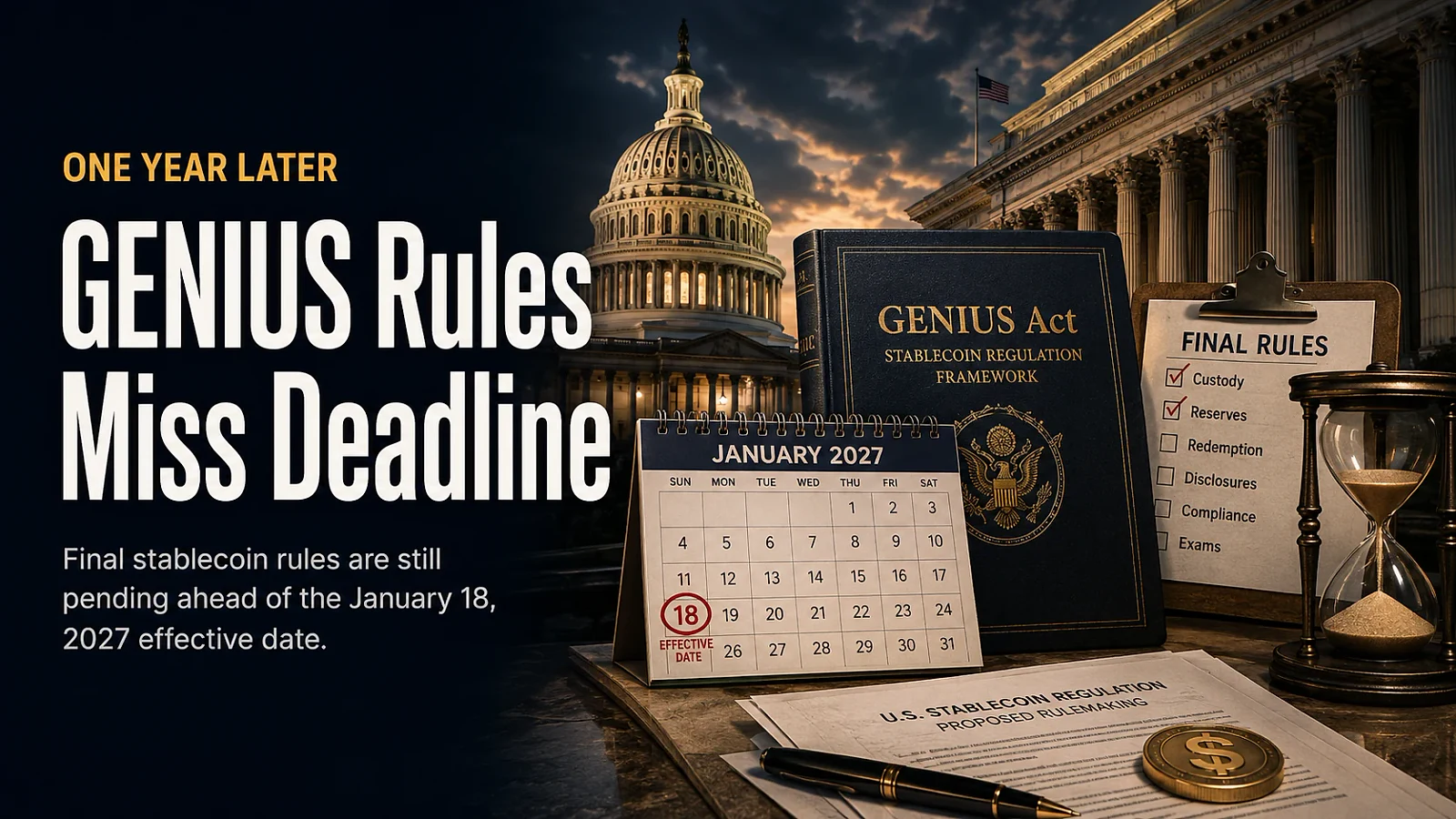
July 18, 2026 marks one year since President Trump signed the GENIUS Act into law, but it also marks a missed statutory waypoint for the stablecoin regime Congress ordered. Final implementing rules from the FinCEN, OFAC, OCC and Federal Reserve were still pending at the deadline, leaving prospective Permitted Payment Stablecoin Issuers, or PPSIs, with statute-level obligations but no completed operating manual. [2][3][4]
That gap does not delay the law indefinitely. Under the Act's effective-date provision, the framework takes effect on the earlier of 120 days after the primary federal regulators issue final implementing regulations or January 18, 2027, 18 months after enactment. With no final package in place by July 18, the accelerated route has not begun, while the January date remains fixed. [1]
A deadline with proposals, not finality
The first year produced substantial agency work. It did not produce the final, coordinated rules that PPSIs need to convert a statutory mandate into applications, policies, vendor contracts and reserve operations. The difference is not semantic. A notice of proposed rulemaking invites comment and can change; a final rule is the text an issuer must build around.
GENIUS Act timeline — Date — Regulatory consequence
Signed into law — July 18, 2025 — Federal framework for payment stablecoin issuance enacted
Statutory rulemaking deadline — July 18, 2026 — Deadline passes with final implementing rules still pending
Earliest effective-date trigger — 120 days after final rules — Could apply only after primary federal regulators issue final regulations
Backstop effective date — January 18, 2027 — Act takes effect even if final rules arrive later
Treasury, through FinCEN and OFAC, issued a joint proposed AML and sanctions rule in April. Its comment period closed June 9. The proposal would treat PPSIs as financial institutions under the Bank Secrecy Act and require effective sanctions compliance programs, but a proposal is not a completed rulebook for transaction monitoring, customer controls and sanctions escalation. [2]
The OCC likewise has a comprehensive proposal, including the federal application route for nonbank entities and uninsured national banks, the class that includes national trust-bank structures. Its draft addresses reserve assets, capital, an operational backstop, applications and registrations. It also puts a number of choices into the open, including liquidity design, affiliated reward arrangements and the reserve-concentration debate, including the disputed 20% reserve cap approach raised in industry discussion. [3]
Agency — Rulemaking area — Status at July 18, 2026
FinCEN and OFAC — PPSI AML and sanctions programs — Joint proposal; final rule pending
OCC — Federal PPSI licensing, reserves, capital and trust-bank pathway — Proposed rule; final rule pending
Federal Reserve — Payment-account access and related issuer access questions — Skinny Payment Account proposal; final framework pending
Treasury-led state process — Standards for state regimes comparable to federal rules — Proposed principles; final determinations pending
The Federal Reserve's May proposal adds a separate but consequential layer of uncertainty. The proposed Payment Account, often called a skinny master account, would offer eligible institutions limited direct access to selected Federal Reserve payment services. Yet it would not expand legal eligibility, would impose a closing balance limit of no more than $1 billion, and would exclude intraday credit, discount-window access and FedACH services. It is a proposal about access, not a promise of a full master account for every stablecoin company. [4]
The PPSI planning problem
For Circle, Paxos, Bridge and Rain, the practical challenge is not whether federal oversight is coming. The Act makes that direction clear. It is how to commit capital and product architecture before the final rules answer operational questions. A company can prepare 1:1 reserves, monthly disclosures, redemption procedures and Bank Secrecy Act controls today. It cannot know with finality how its particular licence application will be judged, what concentration constraints will survive, or how its bank and technology partners must document compliance. [1][3]
The uncertainty extends to enforcement plumbing. The statute requires PPSIs to comply with Bank Secrecy Act and sanctions obligations, while the Treasury proposal will determine the tailored program. The law's freeze mandate must also become a repeatable technical and governance process: who can order a freeze, what evidence is retained, how a wallet-level action is logged and how an issuer reverses an error. Those are implementation decisions, not merely legal footnotes. [1][2]
“Our leadership in finance and technology depends on clear, predictable rules,” House Financial Services Committee Chairman French Hill said at a July 17 Digital Assets Subcommittee hearing. “The country has to have the rules to make the U.S. the center of that digital ecosystem in the world.” [5]
That urgency is increasingly visible in market structure. The Act's uncompleted framework is arriving just as Circle is preparing Arc for institutional stablecoin settlement, Visa is building its stablecoin platform, and asset managers are connecting tokenized-cash products to payment rails. Those projects can launch commercial technology without a final PPSI regime, but their regulated issuance, reserve custody and direct-settlement assumptions depend on it. The result is regulatory drift: infrastructure moves ahead while the permissions that will define its US operating perimeter remain incomplete.
Europe has an operating register
The contrast with Europe is sharp. Stripe-owned Bridge announced Luxembourg MiCA and e-money permissions on July 2, placing an authorised issuer and payments entity inside an operating EU framework that can be passported across 27 member states. That does not make MiCA simple, nor does it resolve every product question. It does give counterparties an identifiable authorisation, regulator and legal entity today.
In the United States, the GENIUS Act has supplied the statutory destination, but final agency rules are still needed to make PPSI licensing, reserve design, account access and freeze compliance operationally predictable. The separate Senate delay around the CLARITY Act compounds the problem by postponing wider market-structure lines between digital-asset activities and financial regulation. For issuers and their institutional partners, the next six months are now less about waiting for a new law than managing the cost of a law whose decisive instructions have not yet arrived.
References
[1] Congress.gov, "S.394, GENIUS Act of 2025, text," April 2, 2025. https://www.congress.gov/bill/119th-congress/senate-bill/394/text
[2] U.S. Department of the Treasury, "Treasury Proposes Rule to Implement the GENIUS Act's Anti-Money Laundering and Sanctions Requirements," April 9, 2026. https://home.treasury.gov/news/press-releases/sb0435
[3] Office of the Comptroller of the Currency, "GENIUS Act Regulations: Notice of Proposed Rulemaking," February 25, 2026. https://www.occ.gov/news-issuances/bulletins/2026/bulletin-2026-3.html
[4] Federal Reserve Board, "Proposed Revisions to the Federal Reserve Policy on Payment System Risk and the Guidelines for Account and Services Requests," May 20, 2026. https://www.federalreserve.gov/newsevents/pressreleases/files/other20260520a3.pdf
[5] House Financial Services Committee, "One Year Later, Digital Assets Subcommittee Highlights the CLARITY Act's Role in Driving Innovation and Protecting Consumers," July 17, 2026. https://financialservices.house.gov/news/documentsingle.aspx?DocumentID=411198