ECB's Appia Consultation Draws 127 Responses Backing Central Bank Money as the Core of Tokenised Finance
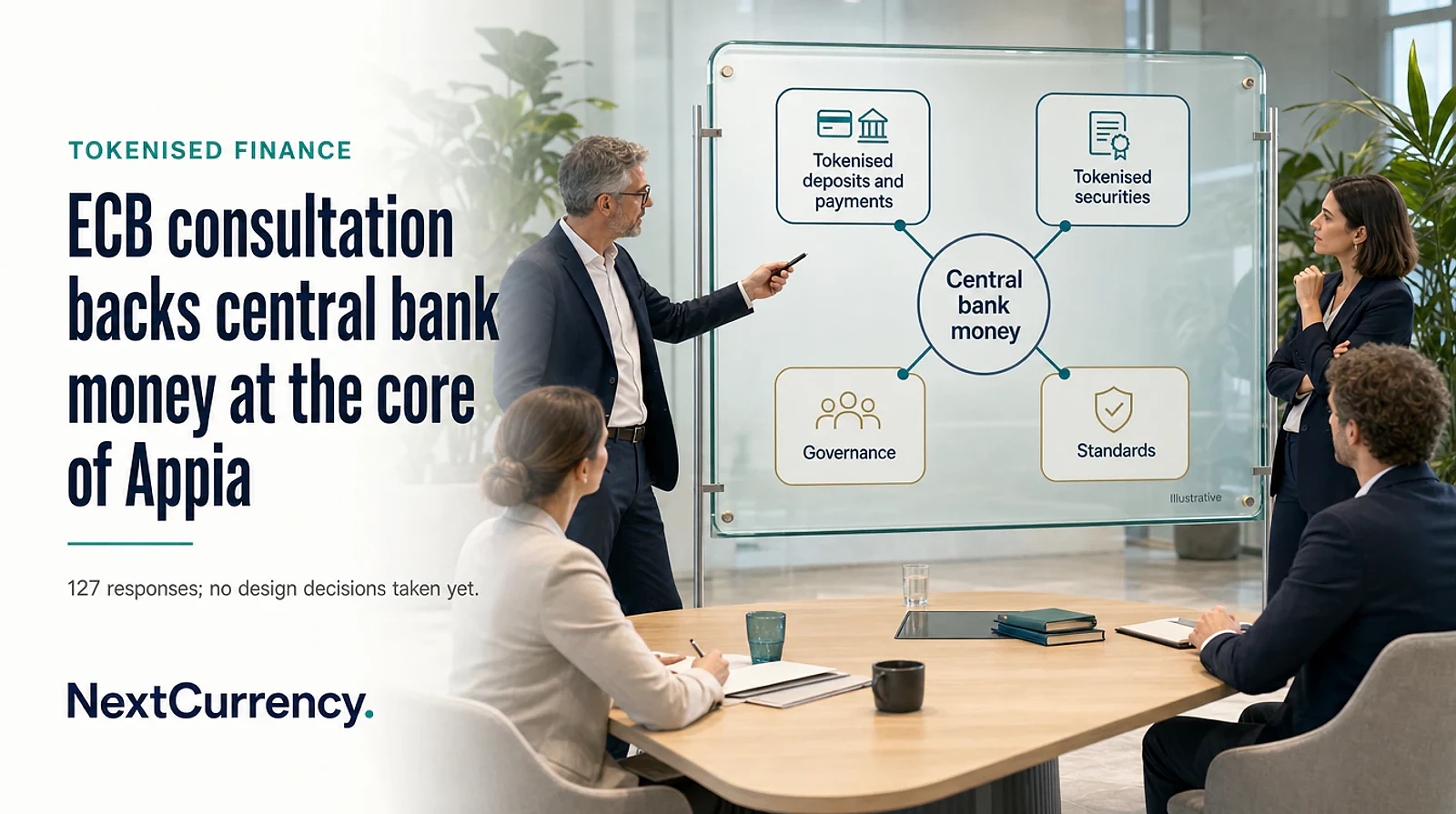
The ECB says no design decisions have been taken; market participants will soon be invited into workstreams on tokenised deposits and payments, tokenised securities, network governance and standards ahead of a 2028 blueprint.
By Lucas Ferreira, Journalist, Crypto Infrastructure
The European Central Bank said on 28 October 2026 that its public consultation on the Appia roadmap drew 127 responses from public and private stakeholders, and that respondents "strongly supported" using central bank money as the foundation of a European tokenised financial ecosystem.
The ECB was explicit that the consultation settles nothing yet. "No decisions have been taken at this stage," it said, and the high-level design options for the ecosystem's architecture will be explored further. As a next step, market participants will "soon be invited" to join workstreams on tokenised deposits and payments, tokenised securities, shared network governance and standards.
Those workstreams, together with the Appia contact group launched in September, are meant to shape the 2028 Appia blueprint.
What respondents told the Eurosystem
According to the ECB, the 127 responses converged on four points:
- Central bank money at the core. Respondents backed central bank money as the anchor, including its role in connecting and ensuring convertibility between the private settlement assets that would sit alongside it, such as tokenised deposits.
- A strong Eurosystem role. Many respondents favoured the Eurosystem providing neutral governance and coordination, rather than leaving the network design to private consortia.
- Standardisation. Standards emerged as a key priority, to avoid fragmentation and to make DLT-based platforms interoperate with existing financial market infrastructures.
- Strategic autonomy and harmonised rules. Respondents supported the roadmap's strategic autonomy objectives and called for harmonised legal and regulatory frameworks across the EU.
The consultation also asked for views on architecture options, and the ECB said respondents "highlighted the trade-offs between them". The ECB did not publish a preferred option.
Where Appia sits
The Eurosystem launched Appia in 2025 and published the roadmap that was consulted on in March 2026. Appia examines how central bank money and collateral services could be provided across different DLT networks and how networks with European governance and common standards could be supported. Its deliverable is a blueprint of findings, recommendations and principles by 2028, not an operating system.
The ECB's consultation page says the Eurosystem plans to publish the individual responses in the second half of 2026 and will evaluate expressions of interest from stakeholders who want to contribute to the next phase.
Why the result matters for tokenised deposits
The clearest signal for banks is the dedicated workstream on tokenised deposits and payments. Respondents framed private settlement assets as complementary to central bank money, with central bank money providing the link and convertibility between them. That puts tokenised deposits and other private settlement assets alongside, rather than instead of, a central bank anchor.
The support for Eurosystem-led governance also matters commercially. If the central bank coordinates network governance and standards, private DLT platforms will need to align with those standards to connect to central bank money. Who participates in the workstreams, and how quickly they report, will indicate how much of that design is shaped by the market before the 2028 blueprint.
Sources
- European Central Bank, "Strong stakeholder support for Appia roadmap paves way for further market engagement", 28 October 2026: https://www.ecb.europa.eu/press/intro/news/html/ecb.mipnews261028.en.html
- European Central Bank, "Public consultation on the Eurosystem's Appia project": https://www.ecb.europa.eu/press/intro/cons/html/eurosystem-appia-project.en.html
- European Central Bank, "Appia" initiative page: https://www.ecb.europa.eu/paym/dlt/appia/html/index.en.html