Custodial vs Non-Custodial Wallets: The Complete 2026 Comparison for Security, Control, and Compliance
The wallet wars are heating up. On one side are custodial wallets—platforms like Coinbase, Kraken, and Revolut that hold your crypto on your behalf.
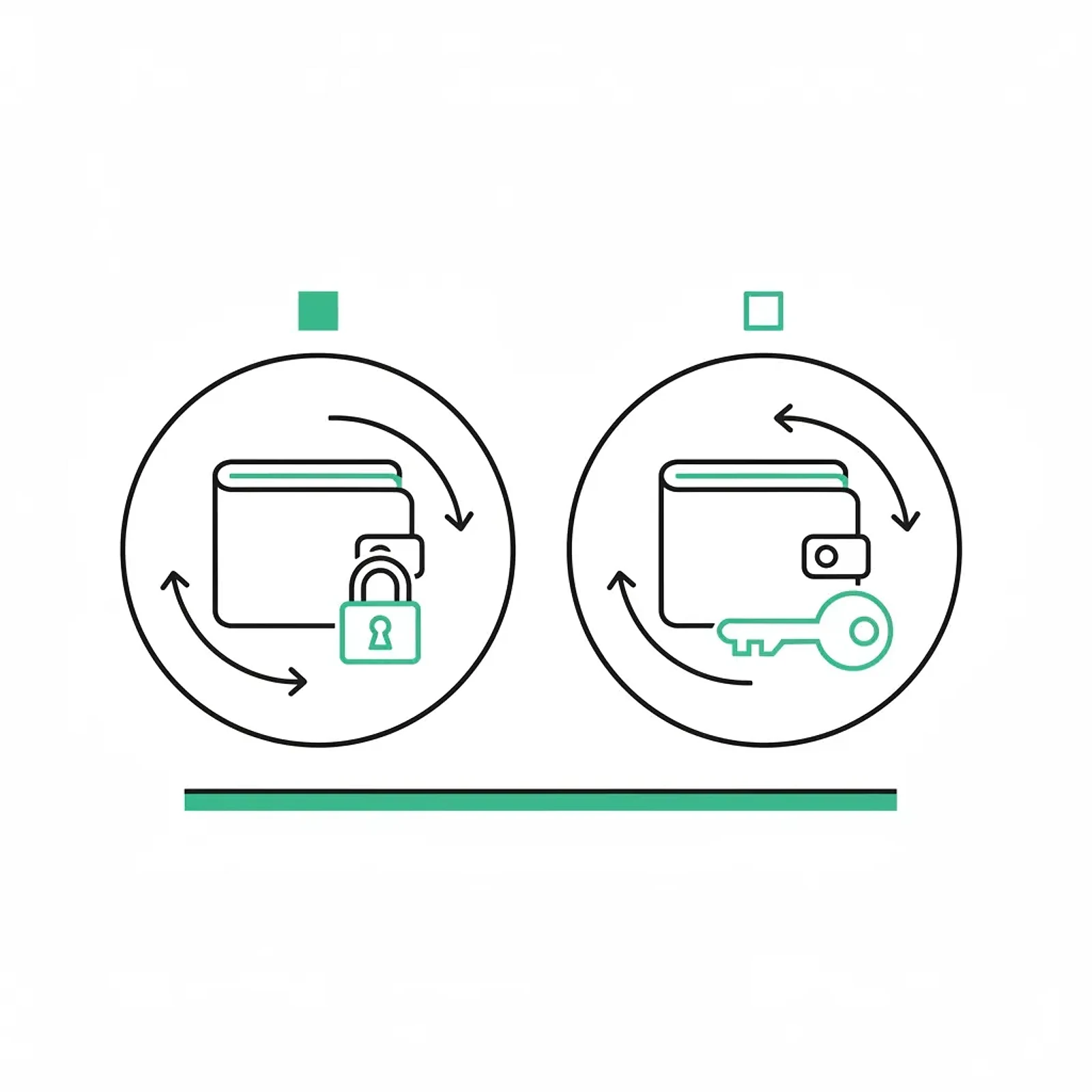
February 3, 2026 — The wallet wars are heating up. On one side are custodial wallets—platforms like Coinbase, Kraken, and Revolut that hold your crypto on your behalf. On the other side are non-custodial wallets—software like MetaMask, Ledger, and Trezor that give you complete control over your private keys. Both categories are growing rapidly. Both are capturing significant market share. But they are fundamentally different products serving fundamentally different customer segments.
Understanding the differences between custodial and non-custodial wallets is essential for anyone investing in crypto. The choice you make will determine not just how you store your assets, but how you interact with the broader crypto ecosystem, what risks you are exposed to, and what opportunities you can access.
The Fundamental Difference: Who Controls Your Keys?
The core difference between custodial and non-custodial wallets is simple: who controls your private keys? In a custodial wallet, the exchange or platform controls your keys. You access your funds through a username and password, just like online banking. In a non-custodial wallet, you control your keys. You access your funds through a seed phrase that only you know.
This one difference has profound implications for security, control, and compliance. It is the difference between trusting a third party to protect your assets and protecting your assets yourself. It is the difference between convenience and sovereignty.
Aspect — Custodial — Non-Custodial
Key Control — Third party holds keys — You control keys
Security Model — Institutional insurance; cold storage — Individual responsibility; self-custody
Access Method — Username/password — Seed phrase/private key
Convenience — High; web/mobile access — Lower; requires key management
Regulatory Compliance — Full KYC/AML required — Minimal compliance
Counterparty Risk — Exchange insolvency — User error/loss
Hacking Risk — Exchange gets hacked — Your device gets hacked
Regulatory Clarity — Regulated; clear rules — Unregulated; unclear rules
Best For — Institutions; convenience seekers — Crypto-native; sovereignty seekers
Custodial Wallets: Convenience and Institutional Security
Custodial wallets have become the primary on-ramp for mainstream users entering crypto. Coinbase, Kraken, and Revolut have made it incredibly easy to buy, hold, and sell crypto. You can open an account in minutes, verify your identity, and start trading. The experience is indistinguishable from traditional online banking.
The security model is institutional-grade. Coinbase, for example, holds 98% of customer assets in cold storage—offline, air-gapped systems that cannot be hacked remotely. The company maintains insurance policies that cover customer losses due to security breaches. The company is regulated by multiple jurisdictions and subject to regular audits.
For institutional investors, custodial wallets are often the only option. Pension funds, hedge funds, and family offices cannot hold crypto in non-custodial wallets because they require institutional-grade custody solutions. Coinbase Custody, Fidelity Crypto Services, and similar platforms provide the security, insurance, and regulatory compliance that institutions require.
But custodial wallets come with trade-offs. First, you are exposed to counterparty risk. If Coinbase goes bankrupt, your assets could be frozen or lost. This is not theoretical—it happened to FTX customers in 2022. Second, you are exposed to regulatory risk. If regulators decide to freeze customer assets, they can do so. Third, you are exposed to platform risk. If Coinbase decides to delist an asset or restrict your access, they can do so.
Non-Custodial Wallets: Sovereignty and Self-Custody
Non-custodial wallets represent the other end of the spectrum. MetaMask, Ledger, Trezor, and similar platforms give you complete control over your private keys. You are responsible for securing your seed phrase. You are responsible for backing up your keys. You are responsible for not losing your keys.
The security model is different. Instead of trusting a third party to protect your assets, you are protecting your assets yourself. If you secure your seed phrase properly, your assets are secure. If you lose your seed phrase, your assets are lost forever. If your device is compromised, your assets could be stolen.
Non-custodial wallets are the only way to access the full crypto ecosystem. If you want to trade on decentralized exchanges, you need a non-custodial wallet. If you want to participate in DeFi protocols, you need a non-custodial wallet. If you want to interact with smart contracts, you need a non-custodial wallet. Custodial wallets do not give you access to these opportunities.
The regulatory landscape for non-custodial wallets is unclear. Some regulators view non-custodial wallets as money transmitters and want to regulate them. Other regulators view them as software and do not regulate them. This regulatory uncertainty creates risks for users in certain jurisdictions.
The Market Dynamics: Convergence and Specialization
The wallet market is not bifurcating into custodial and non-custodial. Instead, it is converging. Custodial platforms are adding non-custodial features. MetaMask is adding custodial features. The result is a spectrum of products, each with different trade-offs.
Coinbase, for example, has launched Coinbase Wallet, a non-custodial wallet that gives users control over their keys while maintaining Coinbase's brand and security standards. Revolut has integrated non-custodial wallet features into its platform. MetaMask has integrated custodial features through partnerships with Fireblocks and other custody providers.
This convergence is driven by market demand. Users want the convenience of custodial wallets with the sovereignty of non-custodial wallets. They want to be able to hold their own keys but also access institutional-grade security. The platforms that can offer both will win.
The Security Comparison: Different Risks, Not Better or Worse
It is tempting to say that non-custodial wallets are more secure than custodial wallets, or vice versa. But this is misleading. They have different security models with different risks.
Custodial wallets are more secure against user error. If you forget your password, Coinbase can reset it. If you accidentally send funds to the wrong address, Coinbase might be able to recover them. If your device is compromised, your funds are still safe because they are held in cold storage.
But custodial wallets are less secure against institutional failure. If Coinbase is hacked, your funds could be stolen. If Coinbase goes bankrupt, your funds could be frozen. If regulators decide to seize customer assets, your funds could be confiscated.
Non-custodial wallets are more secure against institutional failure. No one can hack your wallet except you. No one can freeze your funds. No one can confiscate your assets. But non-custodial wallets are less secure against user error. If you lose your seed phrase, your funds are lost forever. If your device is compromised, your funds could be stolen.
The choice between custodial and non-custodial is not a choice between security and insecurity. It is a choice between different types of risks. The right choice depends on your risk tolerance, your technical sophistication, and your use case.
The Regulatory Landscape: Clarity for Custodial, Uncertainty for Non-Custodial
Custodial wallets operate in a clear regulatory framework. They are regulated as money transmitters or custodians, depending on jurisdiction. They are subject to KYC/AML requirements. They are subject to regular audits. The regulatory landscape is well-established.
Non-custodial wallets operate in an uncertain regulatory landscape. Some regulators view them as money transmitters and want to regulate them. Other regulators view them as software and do not regulate them. Some regulators have not yet decided how to classify them.
This regulatory uncertainty creates risks for users. In some jurisdictions, using non-custodial wallets could be illegal or subject to restrictions. In other jurisdictions, non-custodial wallets are completely legal. The regulatory landscape is evolving rapidly, and users need to be aware of the risks in their jurisdiction.
The Investment Thesis: Both Categories Will Win
For traders and investors, the wallet market is not a zero-sum game. Both custodial and non-custodial wallets will continue to grow. Custodial wallets will capture mainstream users and institutional investors. Non-custodial wallets will capture crypto-native users and sovereignty-focused investors.
The companies that will win are those that understand the fundamental differences between custodial and non-custodial, and that position themselves accordingly. Custodial wallet providers will win by offering superior security, regulatory compliance, and user experience. Non-custodial wallet providers will win by offering superior control, privacy, and access to the full crypto ecosystem.
The companies that will struggle are those that try to be everything to everyone. A custodial wallet that tries to offer non-custodial features will struggle against specialized competitors. A non-custodial wallet that tries to offer custodial features will struggle against specialized competitors.
The future of wallets is not one-size-fits-all. The future is a diverse ecosystem where different wallets serve different needs. Users will choose the wallet that best fits their use case, their risk tolerance, and their technical sophistication.
Key Takeaways:
- Custodial: third party controls keys; institutional security; high convenience; counterparty risk
- Non-custodial: you control keys; self-custody; lower convenience; user error risk
- Custodial wallets: Coinbase, Kraken, Revolut; institutional-grade security; regulated
- Non-custodial wallets: MetaMask, Ledger, Trezor; complete control; unregulated
- Market converging: custodial adding non-custodial features; non-custodial adding custodial features
- Security models different, not better/worse: custodial secure against user error; non-custodial secure against institutional failure
- Regulatory clarity for custodial; uncertainty for non-custodial
- Both categories will win; market is not zero-sum