BIS Payments Committee Sets Out Four Roles for Central Banks as Stablecoins and Tokenised Deposits Spread
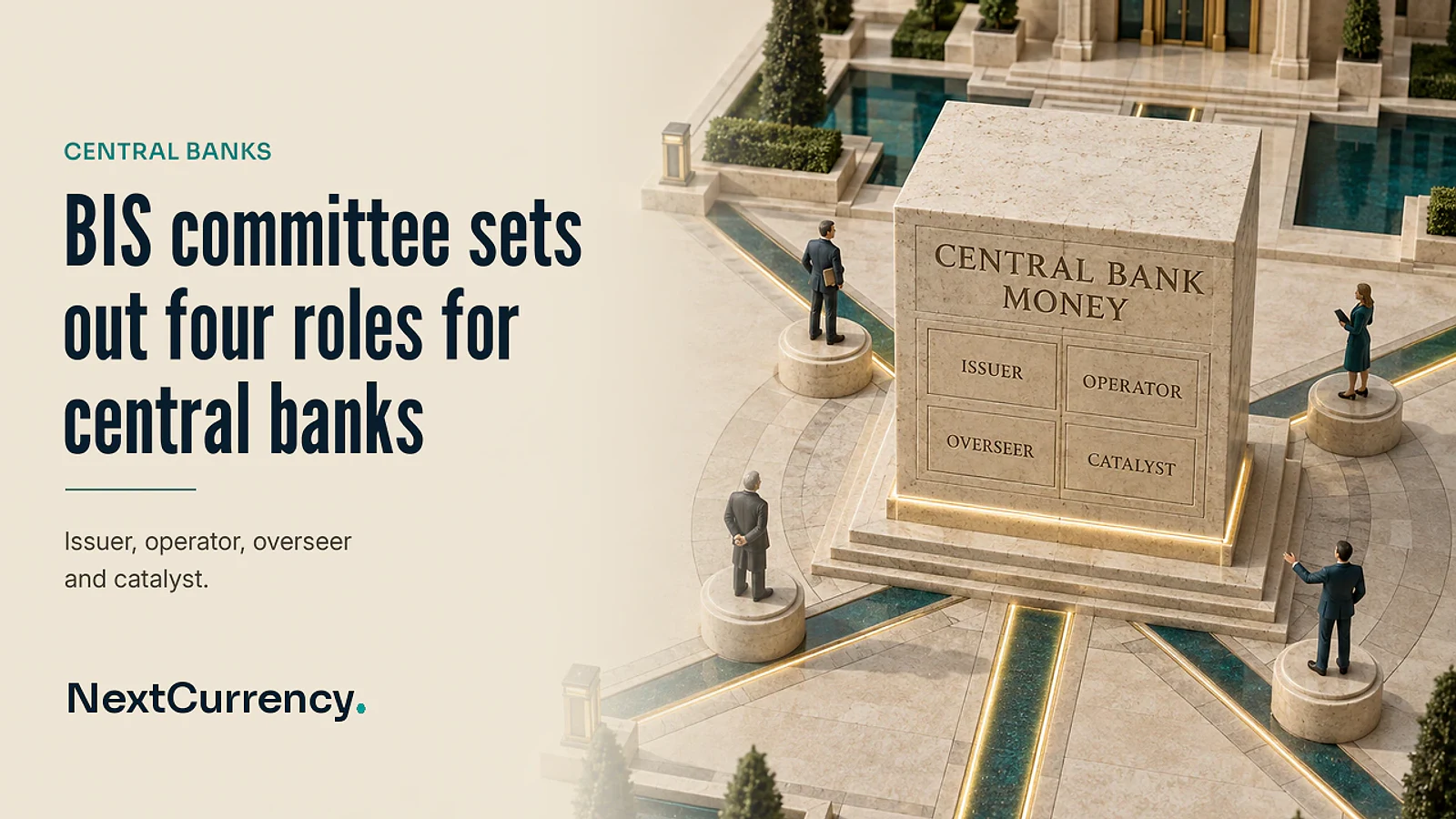
The CPMI's 29 October report says central bank money remains the anchor of trust and the safest settlement asset, and asks central banks to consider their roles as issuer, operator, overseer and catalyst, including whether stablecoins act like market infrastructure. It sets no binding rules.
By Elena Marsh, Journalist, Stablecoins
The Committee on Payments and Market Infrastructures (CPMI), the payments standard-setter hosted by the Bank for International Settlements (BIS), published a report on 29 October 2026 setting out how central banks should respond as stablecoins, tokenised deposits, fast payment systems and non-bank providers change payment systems. The roles of central banks and central bank money in the evolving payment system groups central bank policy tools into four roles: issuer, operator, overseer and catalyst.
The report is analysis and policy considerations, not a binding standard. It does not set rules for any jurisdiction, and it says national approaches may differ.
Central bank money stays the anchor
The CPMI's core finding is that central bank money remains "the anchor of trust" in payments. It provides the safest and most liquid settlement asset for systemically important systems and supports convertibility at par between different means of payment, so that a dollar held as a bank deposit, an e-money balance or another private form can be exchanged one-for-one.
Private money keeps a complementary role, according to the report: private firms drive innovation, competition and access to payment services. The BIS release says the growing diversity of arrangements may bring efficiency and competition but may also create new interdependencies and change how credit, liquidity, operational and cyber risks arise and spread through the system.
The four roles
Role — What the CPMI asks central banks to consider
Issuer — Which entities get access to central bank accounts, for which services and on what terms
Operator — Modernising existing infrastructure or building new platforms, balancing resilience, innovation and implementation risk
Overseer — Whether stablecoins and tokenised arrangements perform functions similar to financial market infrastructures, and their systemic importance, governance and operational resilience
Catalyst — Convening the industry on collective-action problems, supporting market solutions and fostering standards and common practices
"Payments are at the frontier of finance," said Fabio Panetta, Governor of the Banca d'Italia and CPMI Chair, in the BIS release. "Central banks cannot watch this frontier from a distance; they must understand change as it happens and, where necessary, help shape its course."
Why the overseer and issuer questions matter for stablecoins
Two of the four roles bear directly on stablecoin issuers and payment firms. The issuer role covers access to central bank accounts, which decides whether non-banks can settle in central bank money or must rely on a commercial bank. The overseer role asks whether a stablecoin arrangement is doing the job of a payment system or settlement infrastructure, which shapes how closely central banks oversee it.
The report calls for central banks to weigh these tools together, because action in one area can change outcomes in another. It also stresses international cooperation as payment systems become more connected.
The publication updates the framework in the 2003 report The role of central bank money in payment systems from the CPMI's predecessor, and follows the BIS and CPMI report to the G20 on tokenisation published in October 2024. It lands in the same week as the Bank of England's consultation on tokenised collateral in central clearing and the ECB's findings from its Appia roadmap consultation, both of which build on central bank money as the settlement anchor.
Sources
- BIS, CPMI publishes analysis on how central banks support payment system safety and efficiency and trust in money (29 October 2026)
- CPMI, The roles of central banks and central bank money in the evolving payment system (29 October 2026)