Coupang and Woori Bank Complete First End-to-End KRW Stablecoin Payment on Tempo
Coupang and Woori Bank completed Korea's first end-to-end proof of concept for a KRW stablecoin payment, taking a Coupang Eats order from consumer checkout through instant onchain merchant settlement and bank-linked conversion on Tempo.
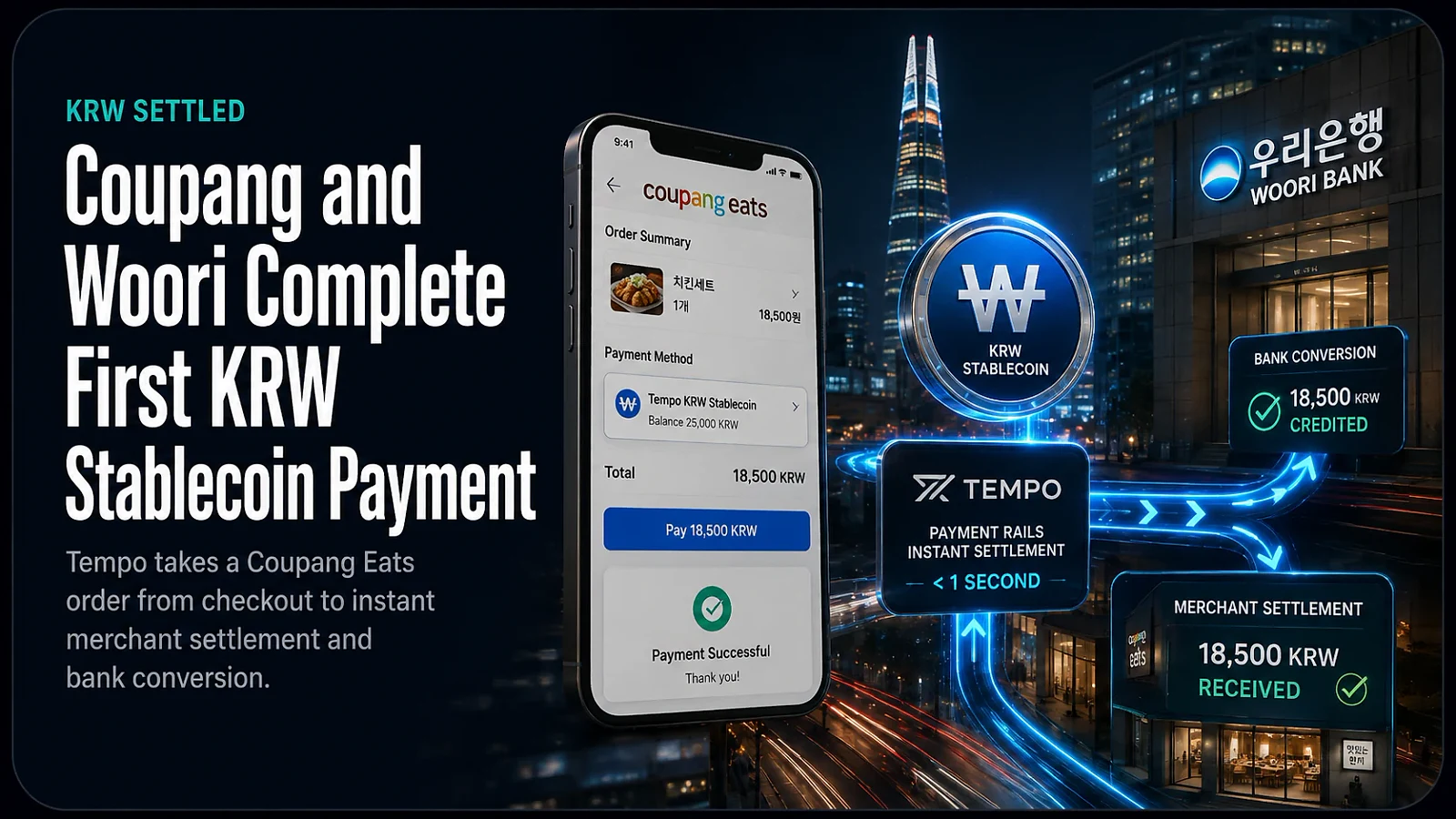
Coupang and Woori Bank have completed Korea's first end-to-end proof of concept for a KRW stablecoin payment and settlement flow, putting a consumer-facing merchant transaction on Tempo, the Stripe- and Paradigm-incubated Layer 1. The July test tracked a Coupang Eats order from customer payment through real-time onchain delivery to the merchant, then through a bank-linked route between the Woori-issued KRW stablecoin and fiat won.[1][2]
This was a commercial-service-like proof of concept, not a nationwide retail launch or a completed Korean rulebook. It joined checkout, merchant settlement, wallets and bank conversion in one flow. For a NYSE-listed platform worth roughly $30 billion, it tests whether stablecoin rails shorten the route from a sale to usable merchant funds.
A merchant payment loop, not a token demonstration
Coupang supplied the merchant-side setting and customer payment experience. Woori, one of Korea's Big Five commercial banks, issued the KRW stablecoin for the test and connected digital wallets to bank accounts for the on-ramp and off-ramp. After an order, the merchant received the KRW-denominated asset on Tempo in real time; the bank-linked account layer made conversion back to fiat possible.[1][2]
The PoC covered the three operational legs a merchant needs: consumer payment, merchant credit and a settlement exit. It resembles a MiniPay-style flow: the customer uses a familiar app while the merchant receives an instant, programmable settlement asset. Transaction volumes, fees, merchant count, consumer rollout timing and production supply were not disclosed.[1][2]
“This PoC represents a meaningful milestone in proactively validating the use of KRW stablecoins for payments and settlement. We will continue expanding financial innovation built on KRW stablecoins as the market and regulatory environment evolves.”
Woori Bank spokesperson.[2]
For merchants, speed is not just a technical metric. Tempo notes that merchant settlement can take from several days to several weeks in conventional arrangements, tying up working capital for smaller businesses. A real-time onchain credit does not eliminate delivery, refund, chargeback or compliance work, but it can separate the cash-availability question from card-network batch cycles.[1]
Why the KRW rail is technically distinct
The token used Tempo's TIP-20 standard. TIP-20 extends ERC-20 with payment-specific elements including transfer memos, compliance controls, policy registries, role-based issuer permissions and an optional currency identifier. Those features matter to a bank-backed payment instrument because an operational team needs reconciliation references, control over minting and redemption, and a way to apply eligibility rules, not merely a transferable token.[3]
Tempo also reserves payment lanes for TIP-20 transfers, designed to keep payment transactions from competing with unrelated blockchain traffic. At present, Tempo says USD-denominated TIP-20 stablecoins can pay network fees, with non-USD fee support planned for the future. The KRW milestone should therefore not be read as proof that every fee, foreign-exchange and liquidity function is already denominated in won. It is proof that a KRW value rail can carry the core payment and merchant-settlement leg.[3]
Tempo payment-rail context — Currency — Timing or scale marker — Relevance to the KRW PoC
KlarnaUSD — USD — Bank-issued Tempo milestone — Establishes the earlier bank-stablecoin precedent on the chain
MGUSD — USD — June 2, 2026, launched on Stellar via Bridge — Multichain comparison, not the settlement asset in this PoC
USD1 — USD — Dollar stablecoin reference — Illustrates the multi-issuer stablecoin market around payment chains
Woori KRW stablecoin — KRW — July 27, 2026, consumer-service PoC — Customer-to-merchant-to-bank settlement test on Tempo
USDB via Bridge — USD — Bridge-linked stablecoin infrastructure — Relevant to issuer and on/off-ramp interoperability, not used in the KRW test
Tempo's ecosystem assigns local rails, KYC, KYB and currency conversion to on-ramp and off-ramp providers, the connective layer Woori supplied here.[4]
Korea moves from token plans to an economic activity test
Korea's planned KGLD and KSVR products test asset backing. Coupang and Woori test a different proposition: whether won can circulate through a merchant economy before returning to the banking system. The commercial loop, not a token launch date, is the central measure.
The regional contrast is sharp. Jupiter and Noah have linked Solana users to SGD and MYR off-ramps, but those are conversion corridors rather than a bank-issued local-currency stablecoin merchant loop. Hong Kong has two licensed issuer paths for HKD products, while the batch's China analysis reports that Beijing has barred unapproved offshore yuan-linked stablecoins. Korea's test sits between those poles: a controlled bank-and-merchant deployment in a country where the domestic framework is still being debated.
APAC market — Local-currency stablecoin position in 2026 — Payment-chain signal — Regulatory implication
Korea — KRW PoC with Woori, Coupang and Tempo — One consumer-to-merchant-to-bank loop — Deployment is ahead of final comprehensive rules
Japan — JPY stablecoin and deposit-token market development — Domestic payment and bank experiments — Regulated issuance path is comparatively established
Hong Kong — 2 initial licensed issuer paths, focused on HKD — Licensed-issuer framework — Hong Kong dollar route is separate from offshore yuan issuance
China — Unapproved offshore CNH stablecoins barred by 8 agencies — State-supervised alternatives favored — Open private yuan stablecoin model is constrained
Korea's proposed Digital Asset Basic Act would provide a formal framework for stablecoin issuance, reserves and redemption, but it remains under discussion rather than in force. Legal analysis of the pending framework says stablecoin issuance would be subject to licensing and reserve requirements, while issuer eligibility and supervisory design remain central policy questions.[5]
That makes Woori's bank role strategically relevant. A working proof of concept gives regulators and market participants a specific operating model to evaluate: wallet controls, merchant settlement, bank-account conversion and the issuer's responsibility for a KRW-denominated claim. It does not settle policy, but it turns a debate about permissible stablecoins into evidence about how a payment loop could work once legislation arrives.
The milestone is a test of real economic activity in a non-USD stablecoin. If law catches up, the next test is merchant-scale performance, pricing, consumer protections, liquidity management and refunds.
References
[1] Tempo, "Coupang and Woori Bank complete Korea's first end-to-end KRW stablecoin payment on Tempo," July 27, 2026. https://tempo.xyz/blog/coupang-woori-bank-krw-stablecoin-payments/
[2] Coupang Newsroom, "Coupang and Woori Bank complete Korea's first commercial-service-based stablecoin payment and settlement technology verification," July 27, 2026. https://news.coupang.com/archives/64957/
[3] Tempo, "TIP-20: a token standard for payments," January 6, 2026. https://tempo.xyz/blog/tip20/
[4] Tempo, "Ecosystem," accessed August 11, 2026. https://tempo.xyz/ecosystem/
[5] Chambers and Partners, "Fintech 2026: South Korea, Trends and Developments," March 31, 2026. https://practiceguides.chambers.com/practice-guides/fintech-2026/south-korea/trends-and-developments