Senate Rejects CLARITY Act Cloture 49–50, Leaving H.R. 3633 Stalled
The September 15 motion to proceed fell 11 votes short of the 60-vote threshold. A motion to reconsider preserves a procedural route, but the Senate has not opened debate on the bill.
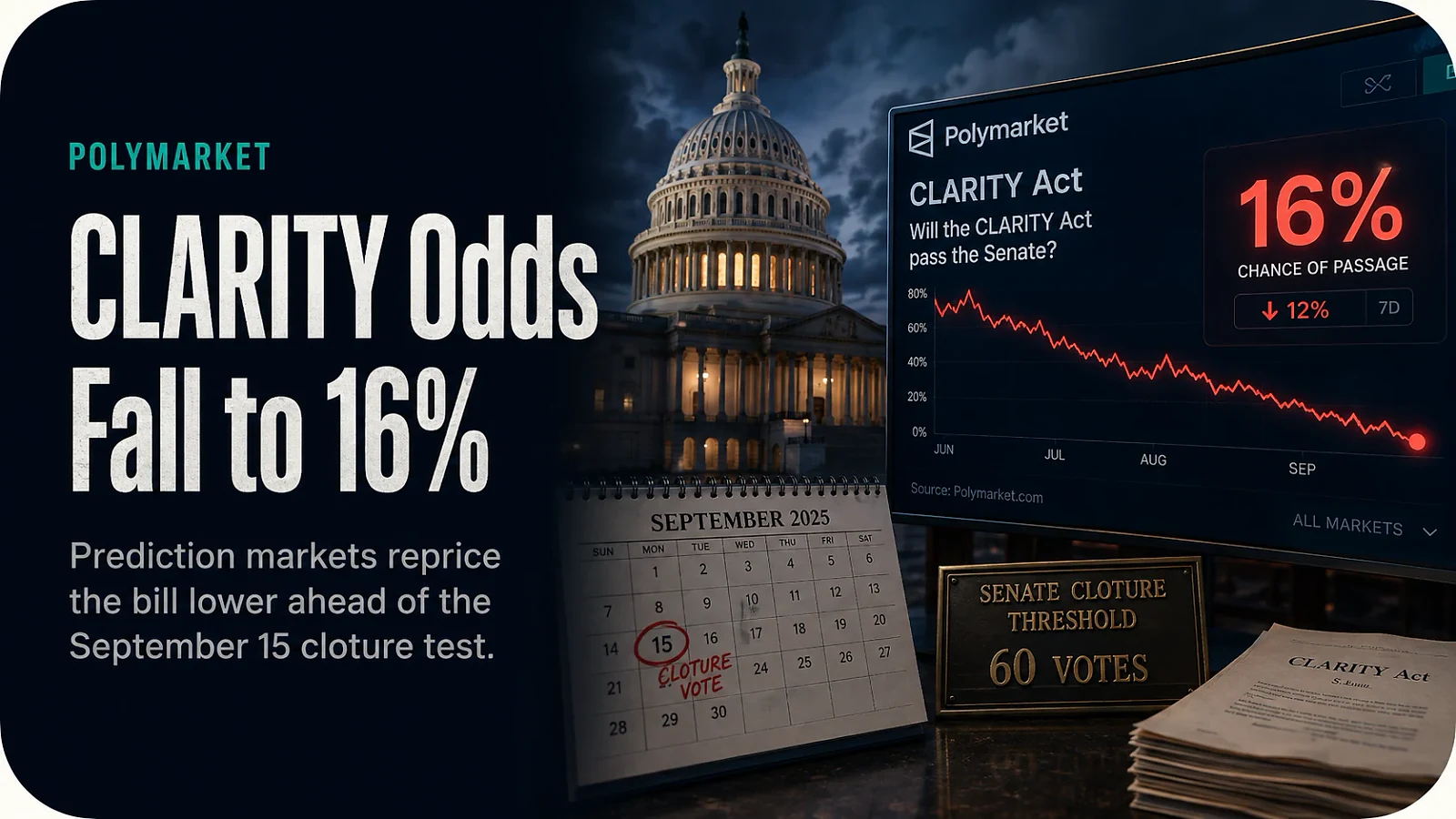
The U.S. Senate rejected cloture on the motion to proceed to the CLARITY Act on September 15, voting 49–50 and leaving H.R. 3633 stalled before floor debate could begin.
The vote required three-fifths of the Senate, or 60 votes with all seats considered. Forty-nine senators voted yes, 50 voted no and one did not vote. The result concerns whether to take up the bill; it is not a vote on final passage and does not enact or repeal any digital-asset rules. U.S. Senate roll call.
No Democrat or independent supported cloture
All 49 yes votes came from Republicans. Republican senators Susan Collins, Josh Hawley, Jerry Moran and Thom Tillis voted no, while every voting Democrat and independent opposed the motion. Senator Chris Coons did not vote.
Tillis voted no to preserve the ability to make a motion to reconsider, according to the Senate Press Gallery's floor log. He made that motion later in the afternoon. The procedural step keeps a possible return vote available, but it does not set a new vote date or demonstrate that the missing votes have been secured. Senate floor log.
The outcome is more decisive than the prediction-market setup in the original version of this article. Before the vote, the central uncertainty was whether a bipartisan group could reach the 60-vote threshold. The roll call shows that the September 15 coalition did not include a single Democratic or independent yes vote and also lost four Republicans.
The bill never reached floor consideration
Cloture was sought on the motion to proceed, the gateway to opening debate on H.R. 3633. Because it failed, the Senate did not move to amendment debate, cloture on the underlying legislation or final passage.
That distinction limits what can be concluded. The vote materially narrows the bill's near-term path, but the measure has not been formally withdrawn, rejected on final passage or permanently barred from reconsideration. Senate leaders could bring the motion back if negotiations produce a different coalition.
H.R. 3633 would establish a federal framework for digital-commodity markets split across the Securities and Exchange Commission and Commodity Futures Trading Commission. The Senate measure also carries provisions affecting Federal Reserve retail services and central bank digital currency use. Those substantive provisions remain proposals because the Senate has not advanced the bill.
Four Republican no votes deepen the arithmetic
With 53 Republican seats, a unified Republican caucus would still have needed seven Democratic or independent votes to reach 60. The four Republican no votes increased the number of crossover votes required in the September roll call, while Coons' absence did not change the three-fifths threshold.
The next viable attempt therefore requires more than scheduling another procedural vote. Supporters would need to recover the Republican defections, attract a bipartisan group, or do both. A motion to reconsider provides the mechanism, not the coalition.
The 49–50 result also separates legislative market structure from narrower agency action. Two days later, the SEC issued temporary conditional relief for tokenized-stock trading venues under its existing Exchange Act authority. That exemption covers a specific form of tokenized NMS stock trading; it does not deliver the comprehensive SEC-CFTC framework contemplated by H.R. 3633. SEC statement.
The next signal is a reconsideration schedule
The prior article tracked market odds and the scheduled cloture test. The verified outcome now replaces that forecast: the September 15 motion failed by 11 votes, and no subsequent successful motion to proceed appears in the cited Senate record.
The bill's status should be reassessed if Senate leadership schedules reconsideration, negotiators release revised text, or named senators announce a changed position. Until then, H.R. 3633 remains introduced and available for further action, but it is not under active floor consideration.