CLARITY Act Lands on Senate Calendar as JPMorgan Flags Sub-50 Percent Passage Odds
The Digital Asset Market Clarity Act reached Senate Legislative Calendar No. 423 on June 1, only to face a JPMorgan research note three days later warning that the bill carries narrower-than-50 percent odds of passage in 2026, squeezed by a crowded legislative calendar and an unresolved stablecoin yield fight backed by the banking lobby.
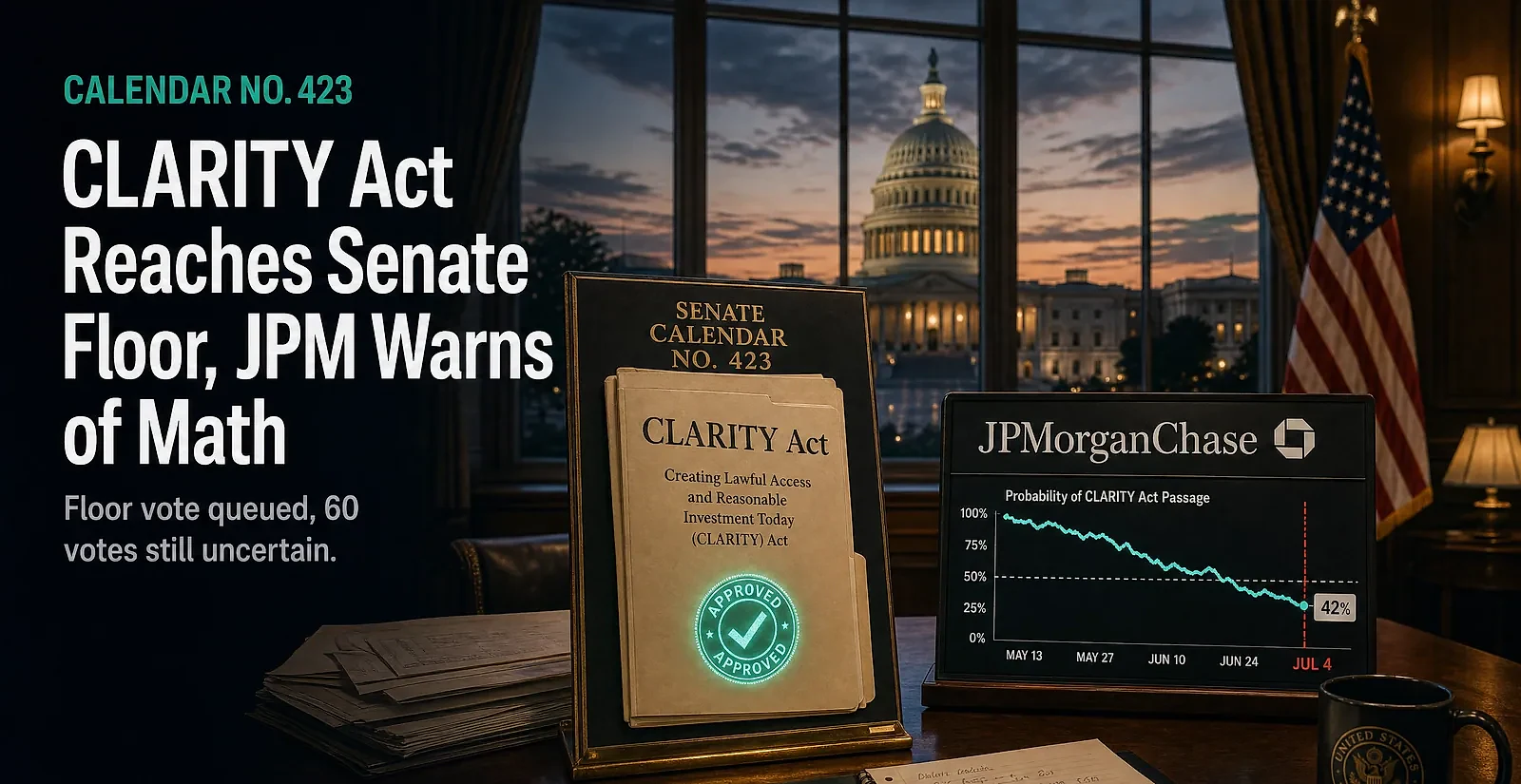
Two developments inside one week have redefined the political trajectory of the Digital Asset Market Clarity Act (H.R. 3633). The bill was formally placed on the US Senate Legislative Calendar under General Orders as Calendar No. 423 on June 1, clearing the final procedural barrier before a full chamber floor vote. Three days later, a research note from JPMorgan managing director Nikolaos Panigirtzoglou threw cold water on optimism: the bank put the bill's odds of passage in 2026 at narrower than 50 percent, citing a compressed legislative timeline and an unresolved stablecoin yield dispute that is drawing coordinated opposition from the traditional banking lobby.[1][2]
From Committee to Calendar: What June 1 Actually Means
Placement on the Senate Legislative Calendar is a procedural milestone, not a guaranteed floor vote. The CLARITY Act cleared the Senate Banking Committee with a bipartisan 15-9 vote on May 14, 2026, chaired by Senator Tim Scott (R-SC), advancing a bill that had already passed the House of Representatives 294-134 in 2025.[2] The calendar entry signals that Senate leadership has formally received the committee's work and the bill is now eligible for scheduling, debate, and amendment on the full Senate floor.
Senator Cynthia Lummis (R-WY), one of the legislation's most vocal champions, said she hopes the chamber can act possibly before the August recess, framing the narrow summer window as the realistic path to enactment.[3] The White House has set July 4, 2026 as an optimistic target, with Treasury Secretary Scott Bessent separately pressing lawmakers to deliver passage by summer.[1]
But calendar eligibility and a scheduled floor vote are different things. Senate floor time is finite and fiercely competed. Appropriations disputes, Pentagon budget debates, and authority reauthorizations are all ahead of the CLARITY Act in the queue. No floor debate date has been announced, and the bill entered June without a confirmed scheduling commitment from Senate Majority Leader John Thune.[2]
JPMorgan Shifts From Catalyst to Caution
Earlier in 2026, JPMorgan's analysts had framed the CLARITY Act as a potential positive catalyst for crypto markets in the second half of the year. The June 4 note, authored by Panigirtzoglou's team, walked that view back with unusual directness.
"With the US midterms approaching, the legislative window for passage of the Market Structure Bill has narrowed, which could postpone progress on crypto market-structure reform this year."
Nikolaos Panigirtzoglou, Managing Director, JPMorgan, June 4, 2026 [1]
The bank identified what it called "several high-friction steps outstanding": securing 60 Senate votes to clear a filibuster threshold, reconciling differences between the Senate and House versions of the bill, and obtaining a presidential signature, all before the chamber departs for its August recess. The arithmetic of those hurdles, layered on top of a midterm election cycle that will absorb legislative bandwidth from September onward, is what pushed the bank's internal probability estimate below 50 percent.[1]
A roughly parallel assessment came from Galaxy Digital research head Alex Thorn, who revised his personal odds from 75 percent to approximately 60 percent on June 6, while noting that Polymarket prediction markets placed passage probability near 54 percent, down sharply from 82 percent in February.[3]
The Stablecoin Yield Fault Line
Behind the calendar math sits a substantive dispute that has proved resistant to compromise. The CLARITY Act attempts to prohibit "passive" stablecoin yield, essentially interest paid on balances, while permitting rewards linked to specific user activity such as payments, transactions, and loyalty programs. The distinction is meant to satisfy banks that stablecoins will not become direct deposit substitutes. It has satisfied neither side.[1]
JPMorgan Chase chief executive Jamie Dimon made the banking industry's position explicit in a late-May television interview, warning that the bill's current yield language is inadequate and that the financial sector would not accept it.
"It allows them to effectively pay interest on deposits, stablecoins or something like that, without the protection that they should have. And it doesn't do anything for AML, BSA, it has almost no legal protections. So no, the banks will not accept it that way. I'm telling you, I would have nothing to do with it and it would eventually blow up on its own."
Jamie Dimon, CEO, JPMorgan Chase [4]
The American Bankers Association operationalized that opposition by mobilizing members to flood Senate offices with more than 8,000 letters criticizing the stablecoin yield compromise negotiated by Senators Thom Tillis (R-NC) and Angela Alsobrooks (D-MD) ahead of the Banking Committee vote.[1] Dimon's direct criticism is particularly notable because JPMorgan simultaneously filed paperwork for blockchain-based tokenized Treasury products that would pass yield to holders, a fact critics have used to characterize the opposition as competitive rather than principled.
The Blockchain Association pushed back on June 3, sending a letter co-signed by 160 former national security and law enforcement officials to both Thune and Senate Democratic Leader Charles Schumer, urging passage.[1] But lobbying pressure from the banking side has been more operationally sustained, and JPMorgan's note acknowledged that growing pushback from financial institutions has materially reduced expectations for enactment this year.
The Counter-Argument: Uncertainty, Not the Bill, Is the Variable
Bitwise Chief Investment Officer Matt Hougan offered a notably different frame for what the legislative delay actually means for crypto markets. Hougan argued that the passage of the GENIUS Act stablecoin framework in 2025 had already delivered a significant portion of the regulatory clarity the industry needed, reducing the CLARITY Act from a make-or-break catalyst to an incremental improvement.
"The CLARITY Act doesn't matter anymore. The industry should continue building products and infrastructure regardless of the bill's outcome."
Matt Hougan, CIO, Bitwise [3]
Hougan's argument is that the primary headwind to institutional participation was never the absence of one specific law but the general uncertainty about whether crypto faced a hostile or permissive regulatory environment. With SEC enforcement posture shifted and stablecoin rules established, that uncertainty has partially resolved independent of the CLARITY Act's fate.[3]
Legislative Scorecard
The following table tracks the CLARITY Act's progress and remaining milestones as of June 4, 2026.
Stage — Status — Date — Vote / Notes
House passage — Completed — 2025 — 294-134 bipartisan
Senate Banking Committee markup — Completed — May 14, 2026 — 15-9 bipartisan
Senate Legislative Calendar placement — Completed — June 1, 2026 — Calendar No. 423
Senate floor vote (60 votes required) — Pending — Unscheduled — ~10 Democratic crossovers needed
House-Senate reconciliation — Pending — Post-Senate vote — Two different texts must be merged
Presidential signature — Pending — Post-reconciliation — No public White House position on current text
The table highlights the asymmetry between completed and pending steps: five procedural stages remain, each with independent failure risk, inside a window of roughly eight working Senate weeks before the August recess.
Key Stakeholder Positions
Stakeholder — Role — Position on CLARITY Act
Sen. Cynthia Lummis (R-WY) — Senate floor champion — Strongly supportive; targets passage before August recess
Sen. Tim Scott (R-SC) — Senate Banking Committee Chair — Supportive; led 15-9 committee vote
Jamie Dimon, JPMorgan Chase — Bank opposition leader — Opposed; warns stablecoin yield provisions will blow up
Nikolaos Panigirtzoglou, JPMorgan — Research analyst — Sub-50% passage odds for 2026
Matt Hougan, Bitwise — Crypto industry — Passage would help but bill is no longer critical
Scott Bessent, US Treasury — Administration — Pressing for summer passage
Alex Thorn, Galaxy Digital — Independent analyst — Revised down to 60% from 75%
American Bankers Association — Bank lobby — Actively opposed; 8,000+ letters sent to Senate offices
What Failure Would Mean
If the CLARITY Act slips past the August recess without a floor vote, the realistic next window is a post-election lame-duck session, where the political dynamics are harder to predict and legislative appetite for controversial votes is lower. JPMorgan noted that a post-midterm compromise could look materially different from one reached before elections, as political incentives shift for members in competitive seats.[1]
The bank also flagged a consequential side effect if passive stablecoin yield is restricted in the final text: capital currently sitting in stablecoins would likely accelerate its shift toward tokenized Treasuries, digital money-market funds, and tokenized deposits, products that banks are better positioned to offer. In that scenario, a bill nominally designed to benefit the crypto industry could channel yield-seeking capital back toward the traditional financial system even if it passes.[1]
For a digital asset market with a combined capitalization of $2.43 trillion and 13,967 tracked assets as of early June 2026, the difference between a clean passage, a compromised passage, and a failure is not a minor regulatory technicality. It is the question of who controls the rules for the next cycle.[2]
References
[1] JPMorgan / crypto.news, "JPMorgan warns the CLARITY Act is running out of time," June 5, 2026. https://crypto.news/jpmorgan-warns-the-clarity-act-is-running-out-of-time/
[2] CoinPaprika, "CLARITY Act Joins Senate Floor Calendar After Banking Committee Vote," June 3, 2026. https://coinpaprika.com/news/clarity-act-joins-senate-floor-calendar/
[3] Brave New Coin, "Bitcoin Price Rebounds From Oversold Levels as Senator Lummis Defends CLARITY Act Against Banking Critics," June 8, 2026. https://bravenewcoin.com/insights/bitcoin-price-rebounds-from-oversold-levels-as-senator-lummis-defends-clarity-act-against-banking-critics
[4] CoinMarketCap, "CLARITY Act Faces Narrow Path to Passage This Year," June 4, 2026. https://coinmarketcap.com/academy/article/%20jpmorgan-warns-clarity-act-faces-delays