CLARITY Act Doesn't Die: Thune Files Cloture on August 8, September Floor Vote Ahead
Senate Majority Leader John Thune filed cloture on the motion to proceed to the CLARITY Act on August 8, preserving a September floor path after the Senate recessed until September 14. The first vote is procedural, but its 60-vote threshold will test whether Republicans can secure the Democratic crossovers needed to move the bill.
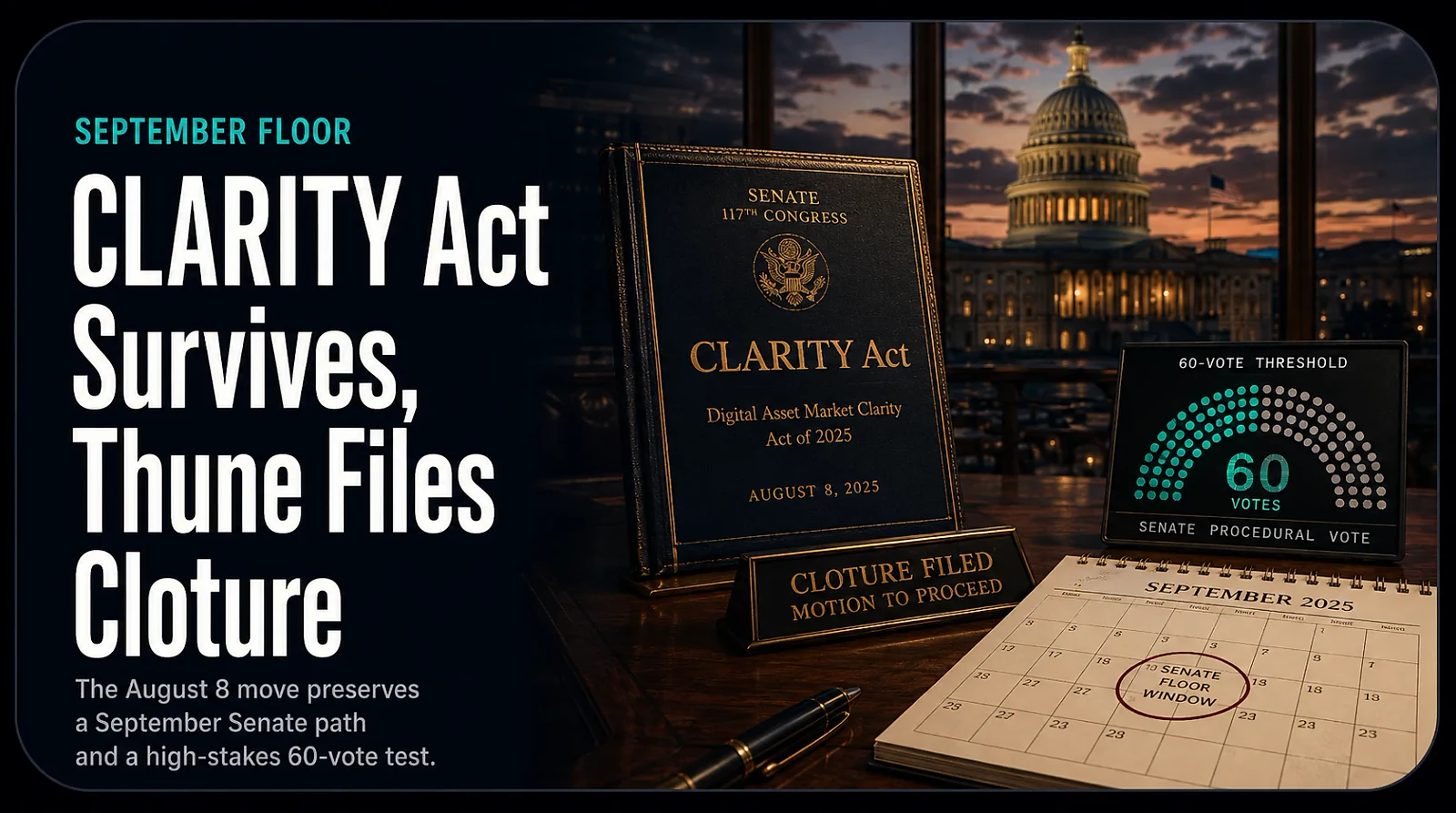
Senate Majority Leader John Thune used the final minutes before the August recess to keep the CLARITY Act on the Senate’s live calendar. On August 8, Thune filed cloture on the motion to proceed to H.R. 3633, a procedural move that preserves a path to floor consideration when senators return on September 14. The filing is not passage, but it converts a bill widely expected to slip through the recess into a defined September test of whether crypto legislation can assemble a bipartisan supermajority.[1][2]
The August 8 Filing
The Senate’s official legislative record shows two actions on August 8: a motion to proceed to the measure and a cloture motion on that motion. In practical terms, Thune asked the Senate first to take up the Digital Asset Market CLARITY Act, then filed the mechanism used to limit debate on that threshold question.[1]
That distinction matters. The Senate will first decide whether to invoke cloture on the motion to proceed. A successful result would unlock consideration of the legislation; it would not enact the bill, settle amendments, or substitute for a later final-passage vote. Reuters characterized the action as a procedural vote that could open the way to a full floor vote, while reporting that Republican leaders still believe a coalition is possible after the break.[2]
The timing is unusually consequential. H.R. 3633 has sat on the Senate Legislative Calendar as Calendar No. 423 since June 1, after the Banking Committee ordered it reported favorably on May 14. The House had already passed its version 294-134 on July 17, 2025. By filing before adjournment, Thune ensured the motion would be ready to ripen after recess rather than requiring Senate leadership to restart the process in September.[1]
CLARITY Act milestone after June 1 — Date — What it means
Placed on Senate Calendar, No. 423 — June 1, 2026 — Bill became eligible for Senate floor action
Senate motion to proceed filed — August 8, 2026 — Leadership formally sought to take up H.R. 3633
Cloture filed on the motion to proceed — August 8, 2026 — Sets the first 60-vote procedural test
Senate recess begins — August 8, 2026 — No final vote before the break
Senate returns — September 14, 2026 — Floor process can resume; the first vote is expected September 15
Why This Matters
Before the filing, the immediate narrative was that the bill had failed to secure floor time before the August departure and would lose momentum in a compressed election-year calendar. The cloture filing changes that calculation. It does not solve the vote problem, but it places a specific procedural decision near the top of the Senate’s return agenda instead of leaving the measure in open-ended negotiations.[2][3]
For the digital-asset sector, the stakes extend beyond a symbolic victory. The measure would create a federal framework for deciding when tokens are securities or commodities and which regulator has authority. Proponents say that clarity is necessary to bring market activity under a durable U.S. rulebook. Banks, however, have pressed senators to close what they view as a stablecoin-yield loophole that could let crypto platforms compete for deposits through customer rewards.[2][3]
The Democratic Ethics Block
The central barrier is not whether the Senate can find a vehicle. It is whether the current draft adequately restricts senior officials’ financial exposure to crypto businesses they could influence. Democrats have argued that the provision’s treatment of existing ventures, its exclusive Department of Justice enforcement route, and its January 20, 2029 sunset leave too much room for conflicts.
“Wild and unserious,” Senator Angela Alsobrooks said of the DOJ-only enforcement approach described in the draft.[4]
The dispute is politically difficult because it reaches President Trump’s family-linked crypto businesses. Reuters reported that Trump disclosed more than $1.4 billion of income from family crypto ventures in the preceding year, while reporting on the bill has identified World Liberty Financial and the president’s personal memecoin among the interests drawing Democratic scrutiny.[2][4] Republican negotiators have resisted adding state-attorney-general enforcement, while Democrats have treated that power as part of a credible ethics safeguard.[4]
The Math: 60 Votes and 7-8 Democratic Crossovers
Cloture requires 60 votes. With Republicans holding 53 seats, the mathematical minimum is seven Democratic or independent crossovers if every Republican votes yes. In a chamber where attendance, defections, and competing amendments can matter, an eighth crossover is the more realistic margin if one Republican is absent or votes no.[2][5]
Senate stakeholder — Known position or leverage — Relevance to the September vote
John Thune, Republican leader — Filed the August 8 cloture motion — Controls the procedural route to a floor test
Senate Republicans, 53 seats — Cannot reach 60 alone — Need 7 votes with full unity, or 8 if one Republican is lost
Democratic negotiators — Seek stronger ethics and enforcement language — Their crossover votes determine cloture
Senate Banking Committee — Cleared the bill 15-9 on May 14 — Supplied the Senate bill now on Calendar No. 423
The 15-9 committee vote included all 13 Republicans and Democratic Senators Ruben Gallego and Angela Alsobrooks, showing that bipartisan support exists in principle. The floor calculation is harder because the 60-vote threshold asks the coalition to hold through a direct vote on opening debate, with the ethics question now more salient than it was during committee consideration. That is why the filing is a signal of confidence, not evidence that the votes have been secured.
What Happens September 14
The Senate returns from recess on September 14, and reporting indicates the cloture vote on the motion to proceed is expected the following day. If 60 senators vote to invoke cloture, the chamber can move into consideration of the bill. If the motion fails, the measure remains vulnerable to being pushed aside by appropriations, nominations, and other September business.[3][5]
Even a successful September 15 vote would leave work ahead. The Senate could face further debate, amendments, and additional procedural votes before final passage. Any Senate-approved version would also have to match the House-approved framework before it could reach the president. The immediate question, therefore, is narrower and more revealing: can sponsors prove that the bill has a bipartisan path at all?
Industry Reaction and What to Watch
The industry’s most immediate gain is time. Filing cloture prevented the recess from becoming an informal end point and gives advocates several weeks to argue for a compromise on ethics language and stablecoin rewards. The sector spent more than $119 million supporting pro-crypto candidates in the 2024 election, according to Reuters, underscoring the political and commercial importance attached to a comprehensive market-structure law.[2]
Watch first for whether Democratic negotiators receive changes to enforcement and restrictions on officials’ crypto ventures. Watch next for Republican unity, because the difference between seven and eight crossovers can decide the procedural vote. Finally, watch whether the September vote produces only a decision to begin debate or the momentum for a complete Senate floor process. Thune’s August 8 action saved the CLARITY Act from recess limbo; September will determine whether it can clear the Senate’s much higher bar.
References
[1] Congress.gov, "All Info: H.R. 3633, Digital Asset Market Clarity Act," August 8, 2026. https://www.congress.gov/bill/119th-congress/house-bill/3633/all-info
[2] Reuters, "US Senate advances landmark crypto bill before heading on August recess," August 8, 2026. https://www.reuters.com/legal/government/us-senate-advances-landmark-crypto-bill-before-heading-august-recess-2026-08-08/
[3] ABA Banking Journal, "Senate adjourns with no vote on Clarity Act," August 8, 2026. https://bankingjournal.aba.com/2026/08/senate-adjourns-with-no-vote-on-clarity-act/
[4] Yahoo News, "CLARITY Act Stalls in Senate as Ethics Provision Draws Democratic Fire," August 4, 2026. https://www.yahoo.com/news/politics/articles/clarity-act-stalls-senate-ethics-111350270.html
[5] The Block, "Majority Leader Thune files cloture on Clarity Act, setting up Sept. 15 Senate vote," August 8, 2026. https://www.theblock.co/news/regulation/2026-08-08-majority-leader-thune-files-cloture-on-clarity-act-setting-up-sept-15-senate-vote-411211