CLARITY Act Clears Senate Banking Committee Markup as Stablecoin Yield Compromise Holds
The Senate Banking Committee convened its long-awaited executive session on May 14 to mark up the Digital Asset Market Clarity Act of 2025, with all 13 Republican votes secured and the Tillis-Alsobrooks stablecoin yield compromise surviving intense last-minute pressure from the banking lobby, Democratic ethics demands, and over 100 filed amendments.
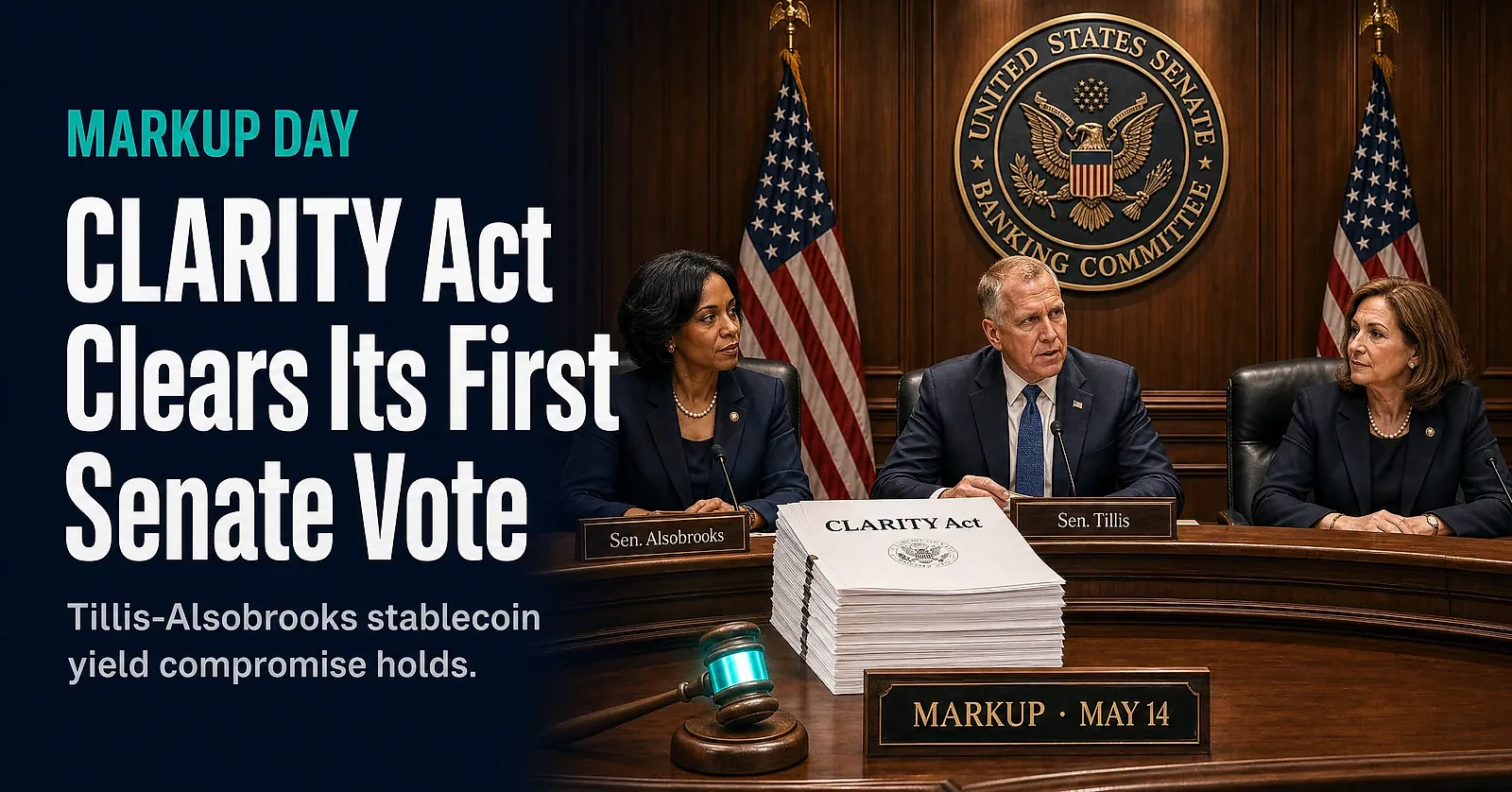
The Senate Banking Committee gaveled open the most consequential markup in U.S. digital asset history on May 14, 2026, convening at 10:30 a.m. ET in Room 538 of the Dirksen Senate Office Building to vote formally on the Digital Asset Market Clarity Act of 2025, known as the CLARITY Act. All 13 Republican committee members confirmed their support before the session began, with Senator John Kennedy of Louisiana, the only credible GOP holdout, announcing he would vote in favor, making passage out of the 24-member panel certain regardless of Democratic participation. [1][2]
Markup Day Mechanics
The committee processed over 100 filed amendments before reaching a final vote on the 309-page Amendment in the Nature of a Substitute released at 12:25 a.m. on May 12 by Chairman Tim Scott (R-SC). [3][4] The substitute text, expanded from a 278-page January draft, reflected months of negotiation on four tracks: stablecoin yield restrictions, DeFi developer protections under the Blockchain Regulatory Certainty Act (BRCA), law enforcement carve-outs, and housing supply policy incorporated as a Kennedy-aligned sweetener through the Build Now Act. [3]
Scott had stated publicly that he needed both unanimous Republican support and meaningful Democratic crossovers to give the bill credible footing for the Senate floor, where passage requires 60 votes. The May 14 session was the first formal committee vote on CLARITY after two previously cancelled markups and an aborted September 2025 effort. [4]
The Tillis-Alsobrooks Stablecoin Yield Compromise
The centerpiece of the May substitute is a substantially rewritten Section 404, renamed from January's permissive "Preserving Rewards for Stablecoin Holders" to the more restrictive "Prohibiting Interest and Yield on Payment Stablecoins." The revision embeds the March 20 agreement between Senators Thom Tillis (R-NC) and Angela Alsobrooks (D-MD), the first bipartisan breakthrough on the stablecoin yield dispute. [3][5]
The core mechanism adds a second prohibition covering payments on a stablecoin balance "in a manner that is economically or functionally equivalent to the payment of interest or yield on an interest-bearing bank deposit." Activity-based rewards remain fully permissible: transactions, liquidity provision, governance voting, staking, loyalty programs, and subscription incentives are enumerated explicitly. Subsection (c)(3)(B) preserves the right for permissible rewards to be calculated by reference to balance, duration, or tenure. [3] Additional structural changes include Treasury joining the SEC and CFTC as a joint rulemaker, a $5 million per-violation civil penalty, and a 90-day good-faith cure period. [3]
The White House Council of Economic Advisers published a 21-page analysis in early April finding that a full stablecoin yield ban would increase bank lending by only $2.1 billion, or 0.02 percent of outstanding loans, materially undercutting the deposit-flight argument. [3]
"We respectfully agree to disagree."
Senator Thom Tillis, posted on X after acknowledging the banking industry would not be fully satisfied with the yield language [1]
Bank Lobby Pushback
The American Bankers Association, Bank Policy Institute, Consumer Bankers Association, Financial Services Forum, and Independent Community Bankers of America issued a joint statement on May 4 crediting Tillis and Alsobrooks for setting the right policy goal while declaring the language fell short. The coalition argued that allowing rewards calculated by reference to duration, balance, and tenure through exchange membership programs created a significant loophole. [5]
"Senators Tillis and Alsobrooks are seeking to achieve the correct policy goal, prohibiting the payment of yield and interest on stablecoins; however, the proposed language falls short of that goal. Research demonstrates that yield-earning stablecoins could reduce all consumer, small-business, and farm loans by one-fifth or more, making it essential for the prohibition to be clear and transparent."
Joint statement from the American Bankers Association and four co-signatories, May 4, 2026 [5]
The banking trades sent an eleventh-hour letter on May 9 formally rejecting the compromise. Despite the pressure, Chairman Scott held the markup date. Coinbase, which had withdrawn support in January, reversed course after the March compromise. CEO Brian Armstrong cited HarrisX polling showing 52 percent voter support versus 11 percent opposition across party lines. [4][6]
Democratic Ethics Demand
The most significant Democratic objection was not the yield question but the absence of ethics provisions. Senators Ruben Gallego (D-AZ) and Kirsten Gillibrand (D-NY) stated explicitly that the bill could not advance without language barring senior government officials from personally profiting from digital assets while in office. [3][7]
Senator Elizabeth Warren (D-MA) cited reports that President Trump's family had earned $1.4 billion from digital asset transactions and filed more than 40 amendments before the markup. [7][8] None of the proposed ethics amendments prohibiting the president, vice president, and federal officials from certain digital asset transactions were included in the May 12 substitute. The White House indicated it would accept across-the-board ethics rules but reject provisions targeting specific officeholders. Chairman Scott suggested the committee's jurisdiction over ethics was limited and the issue might be deferred to the floor. [3]
DeFi Developer Protections
The May substitute preserved Section 604's BRCA language shielding non-controlling software developers and node operators from money transmitter classification. Senator Cynthia Lummis (R-WY) confirmed the developer protections were adopted into the latest draft. [6] A new subsection (d) preserves 18 U.S.C. Section 1960(b)(1)(C) for persons acting with specific intent to transfer funds known to be criminal in origin, addressing the Tornado Cash and Samourai Wallet scenario and satisfying the minimum condition Senator Chuck Grassley set for withdrawing his January objection to BRCA. [3]
Title III added explicit statutory protections for validators, sequencers, oracle providers, node operators, and incident response councils, consistent with the Department of Justice's August 2025 position that truly decentralized, non-custodial software does not constitute money transmission. [3]
Path to a 60-Vote Floor Vote
The committee vote advances the bill to the Senate floor, where it must be reconciled with the Senate Agriculture Committee's version before a unified text can proceed to a 60-vote threshold. [1][3]
Legislative Milestone — Date — Result
House Financial Services Committee markup — June 11, 2025 — Passed 32-19
House Agriculture Committee markup — June 11, 2025 — Passed 47-6
House floor passage — July 17, 2025 — Passed 294-134
Senate Agriculture Committee passage — January 2026 — Passed
Senate Banking first cancelled markup — January 2026 — Postponed
Tillis-Alsobrooks agreement in principle — March 20, 2026 — Reached
Senate Banking 309-page substitute released — May 12, 2026 — Released
Senate Banking Committee markup — May 14, 2026 — Vote held
Senate floor vote (projected) — June or July 2026 — Pending
White House signing target — July 4, 2026 — Pending
Galaxy Research's base case projected a 16 to 8 result with Senators Mark Warner (D-VA), Alsobrooks, and Gallego crossing the aisle; an 18 to 6 outcome would require all five persuadable Democrats. A party-line 13 to 11 result was identified as the downside scenario, one that would meaningfully weaken the floor path. [3] Polymarket priced CLARITY Act passage in 2026 at 69 percent before the markup, up from 43 percent at the end of April, while Galaxy Research's own estimate stood at 55 percent. [3] The White House is targeting a July 4, 2026 signing ceremony, requiring floor passage, House reconciliation with H.R. 3633, and a presidential signature before the August recess. [3][4]
What This Means for Stablecoin Issuers and Card Programs
For issuers such as Circle (USDC) and others in consumer payments, Section 404 as written establishes a workable compliance boundary: passive yield on idle reserves is prohibited; transaction rewards, card incentives, settlement rebates, and loyalty programs remain permissible and may be calibrated to balance or tenure. [3][5]
Key CLARITY Act Provision — Section — What It Does
Stablecoin yield prohibition — 404 — Bans passive deposit-style yield; permits activity-based rewards
BRCA developer immunity — 604 — Shields non-controlling software developers from money transmitter rules
SEC-CFTC jurisdiction split — Title I — Decentralization test determines commodity vs. security classification
Tokenized securities framework — 505 — SEC-only authority with explicit digital asset flexibility
Insider trading rules — 109 — Applies Rule 10b-5 to primary offerings; exempts secondary commodity trading
Insolvency safe harbor — 702 — New protection for digital asset holders in platform bankruptcies
Civil penalty for yield violations — 404 — $5 million per violation, enforced by Treasury on referral
The committee vote confirms Congress will not impose a blanket ban on stablecoin rewards, a result Paul Grewal, Coinbase's chief legal officer, characterized as protecting ordinary customer incentives rather than bank-deposit substitutes. The floor debate will test whether that boundary survives Democratic amendments, but May 14 establishes it as the baseline negotiated position heading into the Senate's most significant crypto vote since the GENIUS Act. [1][6]
References
[1] CNBC, "Major crypto bill slated for May 14 Senate Banking Committee vote," May 8, 2026. https://www.cnbc.com/2026/05/08/congress-crypto-bill-vote-senate-banking-committee.html
[2] CoinNess, "US CLARITY Act secures votes to pass Senate Banking Committee," May 14, 2026. https://coinness.com/en/news/1157220
[3] Galaxy Research (Alex Thorn), "CLARITY Act: Senate Banking Releases New Text," May 12, 2026. https://www.galaxy.com/insights/research/clarity-act-senate-banking-markup-may-2026-analysis
[4] Bitcoin Magazine, "Senate Schedules CLARITY Act Markup As Banking Lobby Mounts Last-Minute Push," May 11, 2026. https://bitcoinmagazine.com/news/senate-schedules-clarity-act-markup
[5] Bank Policy Institute, "Banking Trades Statement on Crypto Market Structure Yield Language," May 4, 2026. https://bpi.com/banking-trades-statement-on-crypto-market-structure-yield-language/
[6] AMBCrypto, "CLARITY Act Update: Lawmakers Adopt Developer Protections into Crypto Bill," May 12, 2026. https://ambcrypto.com/clarity-act-will-improve-lawmakers-adopt-developer-protections-into-crypto-bill/
[7] Forklog, "US Democrats Demand Ethical Amendments to CLARITY Act," May 12, 2026. https://forklog.com/en/us-democrats-demand-ethical-amendments-to-clarity-act/
[8] Yahoo Finance / CCN, "CLARITY Act Faces Over 100 Amendments, as Executives Weigh In," May 13, 2026. https://finance.yahoo.com/news/clarity-act-faces-over-100-110215887.html