Circle Sets September 16 Mainnet for Arc with BlackRock, DTCC, Visa, Mastercard as Founding Validators
Circle has set September 16 for Arc's public mainnet, pairing USDC-native settlement with a founding validator cohort that includes BlackRock, DTCC, Visa and Mastercard. The lineup is a forceful institutional answer to the reported Stripe, Visa, Mastercard and Coinbase stablecoin consortium.
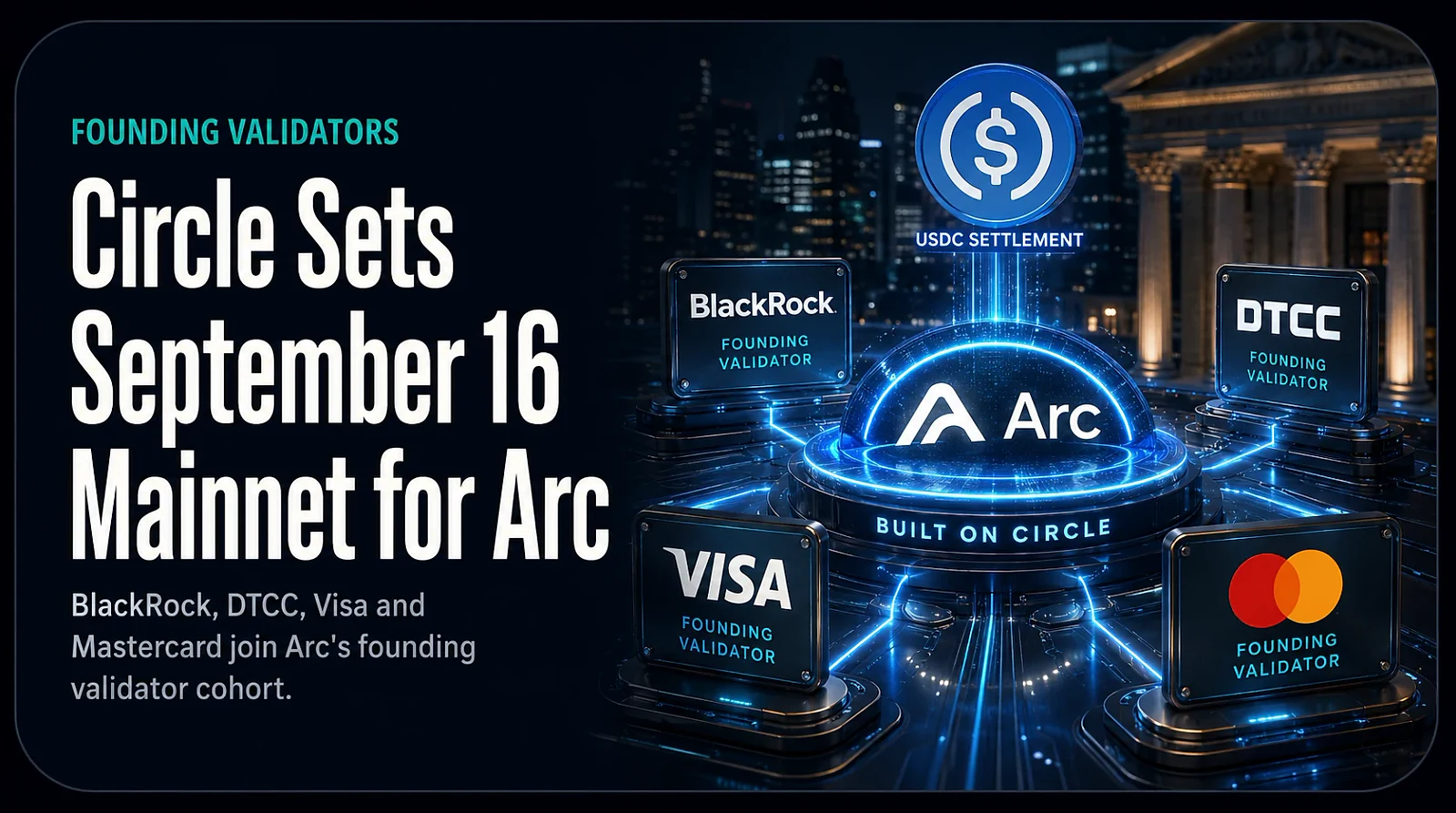
Circle will take its Arc blockchain to public mainnet on September 16, putting BlackRock, DTCC, Visa, Mastercard and other financial institutions into its founding validator cohort. The announcement, made with Circle's second-quarter results on August 5, turns Arc from a product roadmap into a near-term test of whether the issuer of USDC can own more of the settlement stack beneath the dollar token. [1]
The timing is pointed. Visa and Mastercard are validators on Arc while also being reported participants in a prospective stablecoin platform with Stripe and Coinbase. Rather than choosing a single winner, the card networks are securing options across competing rails, leaving Circle to prove that an institution-led chain can convert its USDC distribution into durable infrastructure advantage.
The Announcement
Circle characterized Arc as an institution-focused, EVM-compatible blockchain built for stablecoin settlement, programmable finance and tokenized real-world assets. The public mainnet is scheduled only about five weeks after the earnings announcement. Circle said more than 100 ecosystem and institutional builders were already active around the network, while the launch package would add privacy capabilities and an agent stack. [1]
The headline is not simply that Circle is launching another chain. It is that a stablecoin issuer is inviting some of the firms most exposed to financial-market reliability to participate in network validation. In Circle's framing, the parties relying on network integrity will also help secure it. The group brings Circle alongside BlackRock, which reported $15.3 trillion in assets under management for the second quarter, and DTCC, whose potential pool of DTC-custodied assets runs to roughly $114 trillion. [5][9] That is a deliberately different offer from a public chain whose validator economics are primarily crypto-native, and from a closed bank ledger that does not seek broad developer composability.
Circle reported a profitable quarter alongside the Arc news, but the figures explain why the company wants a new layer of strategic control. USDC onchain volume rose far faster than revenue and supply, an indication that stablecoin utility can expand without automatically producing proportional issuer economics. Arc gives Circle a venue where USDC is native to settlement and where tokenized funds, collateral and payments could be designed around the token from the outset. [1]
“The institutions using USDC today, like BlackRock, BNY, and Standard Chartered aren't piloting, they are expanding.”
Jeremy Allaire, Circle co-founder and CEO [2]
Allaire's claim is an ambition rather than a guarantee. The mainnet launch must show that the validator roster translates into live flows, applications and client integrations. But naming a date and participants makes Arc a measurable operating milestone, not merely a strategic narrative.
The Validator Set: Who Is In
The founding cohort totals 12 named validators when Circle is included, with 11 third parties drawn from asset management, market infrastructure, payments, banking, remittances and digital-asset services. The range matters: it reduces the appearance that Arc is a captive Circle rail while preserving a curated, institution-led starting point. Circle's official release names Sumitomo Corporation, rather than Sumitomo Mitsui Banking, in the announced group. [1]
Validator — Industry role — Why it matters to Arc
Circle — USDC issuer and network sponsor — Native stablecoin settlement and product integration
BlackRock — Asset manager — Expected BUIDL deployment and institutional asset demand
DTCC — Market infrastructure — Potential route to tokenized DTC-custodied assets
Galaxy — Digital-asset financial services — Crypto market and institutional distribution experience
Global Payments — Payments technology — Merchant and enterprise payments perspective
ICE — Exchange and market infrastructure — Capital-markets operating expertise
Mastercard — Payments network — Acceptance and settlement connectivity
MoneyGram — Cross-border remittances — Global money-movement use cases
SBI Group — Japanese financial group — Asia-Pacific institutional reach
Standard Chartered — International bank — Cross-border banking, FX and institutional access
Sumitomo Corporation — Japanese diversified company — Japanese corporate and financial ecosystem reach
Visa — Payments network — Card-linked stablecoin and merchant ecosystem reach
There are tradeoffs in this design. A curated validator set can make risk controls, uptime expectations and institutional accountability easier to organize in the initial phase. It also creates concentration and governance questions that Arc will need to address transparently as it grows. The practical proposition is hybrid: public mainnet access and EVM development on one side, with a validator base selected for regulated financial-market credibility on the other.
The Stripe, Visa, Mastercard and Coinbase Consortium Question
Arc arrives against a more awkward competitive backdrop for Circle. Reporting in June said Stripe, Visa, Mastercard and Coinbase were planning a consortium to issue a new stablecoin, although the companies had not publicly confirmed a name, governance structure or launch date. [3] If built, that platform would combine payment acceptance, stablecoin distribution, exchange liquidity and Stripe's fintech tooling under a shared strategic umbrella.
Visa and Mastercard appearing in both stories is therefore the most important signal in the Arc announcement. Neither network is behaving as if stablecoin settlement will consolidate around a single issuer, chain or consortium. Their participation on Arc gives them direct visibility into USDC-native institutional settlement; their reported work with Stripe and Coinbase preserves exposure to another potential issuance and distribution model.
For Circle, that overlap is not a contradiction so much as a challenge. Its response is to compete on a layer the reported consortium has not publicly defined: a chain where BlackRock and DTCC are not merely customers or integration partners but founding validators. A card network can connect to many rails. A validator role is more operationally embedded, involving network security, governance participation and a reputational commitment to the chain's reliability.
The reset also has a capital-markets dimension. CRCL traded at $62.78 in late July, about 67% below its $189.92 post-IPO peak, according to contemporaneous market commentary. [4] Arc cannot repair a share-price drawdown by announcement alone. It can, however, give investors a clearer answer to a structural question: what does Circle own if stablecoin issuance becomes a crowded, lower-margin business? The intended answer is a settlement network with USDC at its center.
BlackRock BUIDL Comes to Arc
BlackRock is expected to deploy BUIDL, its BlackRock USD Institutional Digital Liquidity Fund, on Arc. [1] That matters because the product joins an institutional cash-equivalent asset with a chain designed to make USDC-native settlement part of the base environment. Circle said the combination is meant to allow institutional investors to subscribe, redeem and deploy fund assets within one onchain setting. [2]
The strategic prize is not a logo. If BUIDL activity on Arc becomes meaningful, the chain could pair tokenized fund shares with a dollar settlement asset and a validator group that includes market infrastructure and payment networks. That is closer to the workflow institutions recognize: cash, collateral, fund units, custody and settlement, rather than a standalone blockchain application.
The deployment remains prospective. Investors should distinguish an expected launch from disclosed assets, transaction volumes or client commitments on Arc. Still, BlackRock's role as both validator and expected BUIDL deployer makes it the most consequential early test of whether Arc can support an institutional asset lifecycle rather than just stablecoin transfers.
DTCC's 2027 Tokenization Bet
DTCC's planned work has a longer horizon. Circle said DTCC will enable tokenization of DTC-custodied assets on Arc; industry reporting places Arc support in the second half of 2027 within the broader DTCC Tokenization Service roadmap. [1][5] That places the opportunity well beyond the September mainnet event, but potentially at a much more consequential point in Arc's development.
DTCC brings a different kind of institutional credibility than a bank or asset manager: it sits in the machinery of post-trade market infrastructure. The relevant question is whether tokenized representations can carry the legal, operational and risk controls required by conventional securities markets, while gaining the speed and programmability that onchain settlement promises.
“We believe tokenization will significantly change how markets work and operate, bringing new levels of liquidity, transparency and efficiency to investors.”
Frank La Salla, DTCC president and CEO [6]
The 2027 target should be read as an option on future workflow, not as current Arc volume. Its value to Circle is nonetheless substantial. A credible path to DTC-custodied assets would make the chain more relevant to collateral, fund settlement and corporate actions, areas where stablecoin utility is only one component of a larger institutional stack.
Chain Wars: Arc vs Tempo vs Canton vs Base
Arc is entering a crowded field, but the field is segmenting by institutional customer and strategic sponsor rather than converging on a single architecture. Tempo, incubated by Stripe and Paradigm, is a payments-first blockchain for stablecoins and real-world payments. [7] Canton concentrates on privacy-aware institutional workflows and interoperability. Base, incubated by Coinbase, is an Ethereum Layer 2 built on the OP Stack and aimed at a broad developer ecosystem. [8]
Network — Primary sponsor or anchor — Core positioning — Settlement or fee design — Institutional signal
Arc — Circle — EVM-compatible institutional chain for stablecoin settlement and tokenized assets — USDC-native settlement — September 16, 2026 public mainnet; BlackRock, DTCC, Visa and Mastercard in founding cohort
Tempo — Stripe and Paradigm — Payments-first Layer 1 for stablecoins and real-world payments — Stablecoin-oriented payments design — Stripe and Paradigm sponsor; payment and AI-agent focus
Canton — Digital Asset ecosystem — Privacy-aware institutional finance and interoperability — Institutional workflow and synchronized-ledger model — JPMorgan, Goldman Sachs and DTCC ecosystem participation
Base — Coinbase — Ethereum Layer 2 for developers and consumer-facing onchain apps — ETH is the native gas asset — Coinbase distribution and OP Stack connection
The comparison clarifies Arc's bet. It is neither trying to be the most neutral multi-issuer payments rail, as Tempo presents itself, nor simply an Ethereum scaling layer like Base. Nor is it identical to Canton, which has built its identity around privacy and interoperable institutional workflows. Arc is attempting to make Circle's regulated stablecoin a native settlement primitive inside a public, EVM-compatible chain governed initially by institutions that already move capital at scale.
That positioning creates an obvious tension: a USDC-native chain can deepen utility for USDC but may appear less issuer-neutral than Tempo. The reward, if the strategy works, is that Circle captures greater strategic relevance as settlement migrates from token issuance to applications and asset workflows.
What This Means for USDC
Circle's second-quarter operating data show the scale on which Arc will be judged. USDC ended June with $73.3 billion in circulation, while quarterly onchain transaction volume reached $14.8 trillion. Revenue and reserve income totaled $701 million, and adjusted EBITDA was $143 million. [1]
Q2 2026 Circle metric — Result — Year-over-year change
USDC in circulation at quarter end — $73.3 billion — 19%
USDC onchain transaction volume — $14.8 trillion — 151%
Revenue and reserve income — $701 million — 7%
Adjusted EBITDA — $143 million — 8%
Net income — $48 million — Improved by $530 million
The divergence between 151% volume growth and 7% revenue growth is the central economic backdrop. It suggests that high transaction throughput does not, on its own, settle the question of monetization. Arc could help Circle influence where USDC is held, exchanged for tokenized assets, used as collateral and incorporated into financial applications. It will not eliminate competition from another stablecoin or the possibility that large distributors demand a greater share of economics.
What to Watch for September 16
The launch-day scorecard should be concrete. First, whether the named validators are operating and whether Circle details governance, uptime and contingency arrangements. Second, whether BUIDL is deployed with usable subscription and redemption flows rather than simply announced. Third, whether developers and institutional builders release applications that demonstrate why Arc needs to exist alongside Tempo, Canton and Base.
The fourth question is distribution. Visa and Mastercard can be validators without routing material transaction activity to the chain. Circle will need evidence that the relationships create settlement, card, treasury or cross-border flows. The September event is therefore less a finish line than a disclosure deadline. Circle has assembled a formidable table; the market will now ask what actually clears on it.
References
[1] Circle Internet Financial, "Circle Reports Second Quarter 2026 Results," August 5, 2026. https://www.circle.com/pressroom/circle-reports-second-quarter-2026-results
[2] Yahoo Finance, "Circle Internet Group Inc. Q2 2026 Earnings Call Transcript," August 5, 2026. https://finance.yahoo.com/quote/CRCL/earnings/CRCL-Q2-2026-earnings_call-665890.html
[3] The Information, "Stripe, Visa, Mastercard, Coinbase to Form Consortium to Issue New Stablecoin," June 4, 2026. https://www.theinformation.com/briefings/stripe-visa-mastercard-coinbase-form-consortium-issue-new-stablecoin
[4] Value Add VC, "Circle Stock (CRCL) 2026: $15B Market Cap, $77B in USDC and Why Shares Are Down 67% From Their Peak," July 31, 2026. https://valueaddvc.com/blog/circle-stock-crcl-2026-15b-market-cap-77b-usdc-and-why-shares-are-down-67-from-their-peak
[5] Ledger Insights, "BlackRock, DTCC, ICE, Visa Among Circle's Arc Blockchain Founding Validators," August 5, 2026. https://www.ledgerinsights.com/blackrock-dtcc-ice-visa-among-circles-arc-blockchain-founding-validators/
[6] Business Wire, "DTCC Advances Development of New Tokenization Service, Convenes 50+ Firms to Drive Digital Assets Adoption," May 4, 2026. https://www.businesswire.com/news/home/20260504182092/en/DTCC-Advances-Development-of-New-Tokenization-Service-Convenes-50-Firms-to-Drive-Digital-Assets-Adoption
[7] Paradigm, "Tempo: The Blockchain Designed for Payments," September 4, 2025. https://www.paradigm.xyz/writing/tempo-payments-first-blockchain
[8] Coinbase, "Introducing Base," February 23, 2023. https://www.coinbase.com/blog/introducing-base
[9] BlackRock, "BlackRock Reports Second Quarter 2026 Diluted EPS," July 15, 2026. https://www.blackrock.com/corporate/newsroom/media/press-releases/blackrock-reports-second-quarter-2026