Circle Q2 2026: USDC Volume Hits $14.8 Trillion Even as Supply Retreats from March Peak
Circle's second-quarter results showed a sharp split between USDC usage and outstanding supply: onchain volume climbed 151% year over year to $14.8 trillion, while quarter-end circulation fell to $73.3 billion amid a wider stablecoin-market pullback.
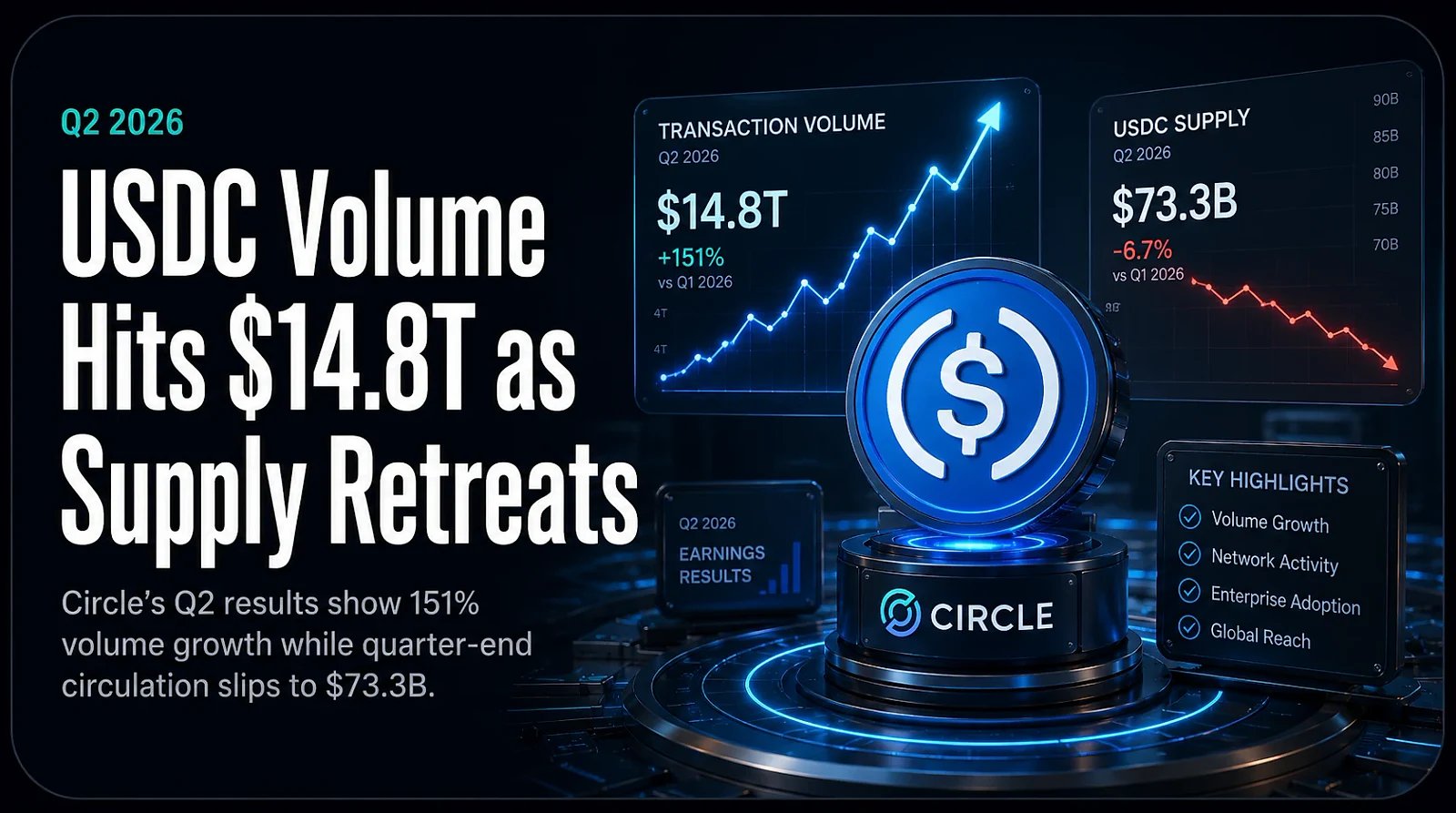
Circle Internet Group (NYSE: CRCL) reported second-quarter results on August 5 that put the tension in the stablecoin market into unusually clear relief. USDC onchain transaction volume rose 151% year over year to $14.8 trillion, yet quarter-end supply slipped to $73.3 billion from the March peak near $80 billion, leaving investors to weigh intense network use against a smaller pool of dollars held in circulation.[1]
The financial read-through was similarly mixed. Revenue and reserve income reached $701 million, up 7% from a year earlier, while adjusted EBITDA rose 8% to $143 million and net income was $48 million.[1] But revenue advanced only modestly as the reserve return rate declined, and shares moved from an almost 8% pre-market gain to a decline of nearly 4% in early trading after the revenue miss came into focus.[3]
Volume Is Surging, Supply Is Not
The central fact in Circle's quarter is not that activity slowed. It is that the measure of activity that matters most for network utility continued to grow very quickly even as the balance of outstanding USDC contracted. Circle recorded $14.8 trillion of onchain transfers in Q2, equivalent to an average of $163 billion a day, according to management.[2] That figure is not a measure of unique payments or unique customers, since the same USDC can move repeatedly through trading, settlement, liquidity and treasury flows. It is, however, a direct measure of how much value the network carried.
Supply gives a different signal. USDC closed Q1 at $77.0 billion and finished Q2 at $73.3 billion, a $3.7 billion sequential reduction. The retreat follows the March peak near $80 billion and occurred as the wider stablecoin market pulled back for the first time in four years, separating the size of outstanding balances from the pace of transactions.[5] Circle's average Q2 circulation still reached a record $76.5 billion, which helps explain why reserve income rose, but the quarter-end number is the more immediate indicator of redemption and minting pressure.[1]
Metric — Q2 2026 — YoY Change — Q1 2026 — QoQ Change
Revenue and reserve income — $701 million — +7% — $694 million — +1%
USDC onchain transaction volume — $14.8 trillion — +151% — $21.5 trillion — -31%
USDC circulation, quarter end — $73.3 billion — +19% — $77.0 billion — -5%
Adjusted EBITDA — $143 million — +8% — $151 million — -5%
Net income from continuing operations — $48 million — Improved by $530 million — $55 million — -13%
The sequential volume decline is as important as the annual increase. Q1's $21.5 trillion total was $6.7 trillion higher than Q2, and Allaire said the first quarter included significant market-maker activity. That framing matters because it counters the temptation to read the 151% annual gain as a straight line. The Q2 result still demonstrates enormous throughput, but it also reflects a colder digital-asset market and less trading-oriented demand than three months earlier.[2]
A Reserve Business Meets Lower Rates
Circle's income statement remains tied principally to the reserves backing USDC. Reserve income increased 5% to $668 million, while average USDC circulation rose 25%; the gap reflects a 66-basis-point year-over-year decline in the reserve return rate to 3.48%.[1] In practical terms, higher average balances generated more income, but each dollar of those balances earned less.
That is why the 151% increase in transfer volume did not produce comparable revenue growth. Network volume can support liquidity, distribution and strategic relevance, yet it does not mechanically lift reserve income when supply is down and interest rates are lower. Other revenue reached $34 million, up 41% year over year, but the core earnings model is still sensitive to the level of USDC outstanding, the rate earned on reserves and the cost of distribution.[1]
The gap also clarifies why Circle continues to defend distribution. The company had already stated a goal of reaching $150 billion in USDC supply during the second half of 2026, a target that now requires a substantial acceleration from the June quarter-end level.[4] The volume data make a case that the network remains useful; the supply data show why conversion of that utility into durable deposits is the next test.
Allaire's Defense Is Network Depth
Chief Executive Jeremy Allaire used the earnings call to answer the competitive question head-on. With reported efforts by Stripe, Visa, Mastercard and Coinbase raising the prospect of an alternative distribution coalition, he argued that Circle's existing network is the asset a new platform would struggle to recreate.[2]
“Our position has never been stronger. At the center of that position is USDC and the extraordinary network we have built around it.”
Jeremy Allaire, Circle co-founder, CEO and chairman, on the Q2 2026 earnings call.[2]
The defensiveness is tangible. Allaire said the Coinbase agreement renewed on its existing terms, preserving USDC's role across Coinbase products.[2] That renewal matters because Coinbase is both a major distribution partner and one of the firms linked to possible rival infrastructure. It does not remove competitive risk, but it limits the near-term case that Circle will lose a key channel just as large payment networks explore stablecoin rails.
Circle's other answer is Arc, its blockchain for payments and financial-market workflows. The public-mainnet launch scheduled for September 16 is covered in the company's separate product announcement; in this earnings report, its relevance is strategic rather than merely technical.[1] Arc gives Circle a way to turn USDC from a token distributed across other chains into the native settlement asset of an institutionally oriented network. More than 100 ecosystem and institutional builders were active on Arc private mainnet, with BlackRock, DTCC, Visa, Mastercard and others named among the planned validator cohort.[1]
What the Market Is Pricing
CRCL's sharp post-IPO rerating supplies the market context. The shares had reached a post-IPO peak of $189.92, but were quoted at $62.78 in July, down 67% from that high. The August 5 reaction showed that investors are no longer rewarding a headline volume beat by itself. They are asking whether USDC circulation can resume rising, whether reserve economics can withstand lower rates and whether Circle can turn Arc, payments and services into growth engines that are less rate-sensitive.
The answer from Q2 is bifurcated. USDC's $14.8 trillion of transfers says Circle retains a high-velocity, deeply used settlement network. The move from $77.0 billion to $73.3 billion of quarter-end supply says the network is operating inside a contracting market and has not yet converted that use into renewed balance growth. The September Arc launch and Coinbase renewal strengthen Circle's distribution defenses, but the $150 billion supply goal now makes H2 execution measurable rather than aspirational.
References
[1] Circle Internet Group, “Circle Reports Second Quarter 2026 Results,” August 5, 2026. https://www.circle.com/pressroom/circle-reports-second-quarter-2026-results
[2] Circle, “Event Replay: Circle Q2 2026 Earnings Call,” August 5, 2026. https://www.youtube.com/watch?v=Kn9LnHZAm88
[3] Reuters, “Circle shares fall as revenue miss overshadows quarterly profit beat,” August 5, 2026. https://www.reuters.com/business/finance/circles-quarterly-revenue-rises-stablecoin-circulation-accelerates-2026-08-05/
[4] Circle Internet Group, “Circle Reports First Quarter 2026 Results,” May 11, 2026. https://www.circle.com/pressroom/circle-reports-first-quarter-2026-results
[5] Forbes, “The Stablecoin Market Shrank for the First Time in Four Years. Watch the Volumes Instead,” July 27, 2026. https://www.forbes.com/sites/digital-assets/2026/07/27/the-stablecoin-market-shrank-for-the-first-time-in-four-years-watch-the-volumes-instead/