BlackRock Files for Two Tokenized Funds on Ethereum ERC-20
The world's largest asset manager has submitted two SEC registration statements for on-chain fund structures backed by U.S. Treasuries and money-market instruments, building on the $2.5 billion BUIDL blueprint.
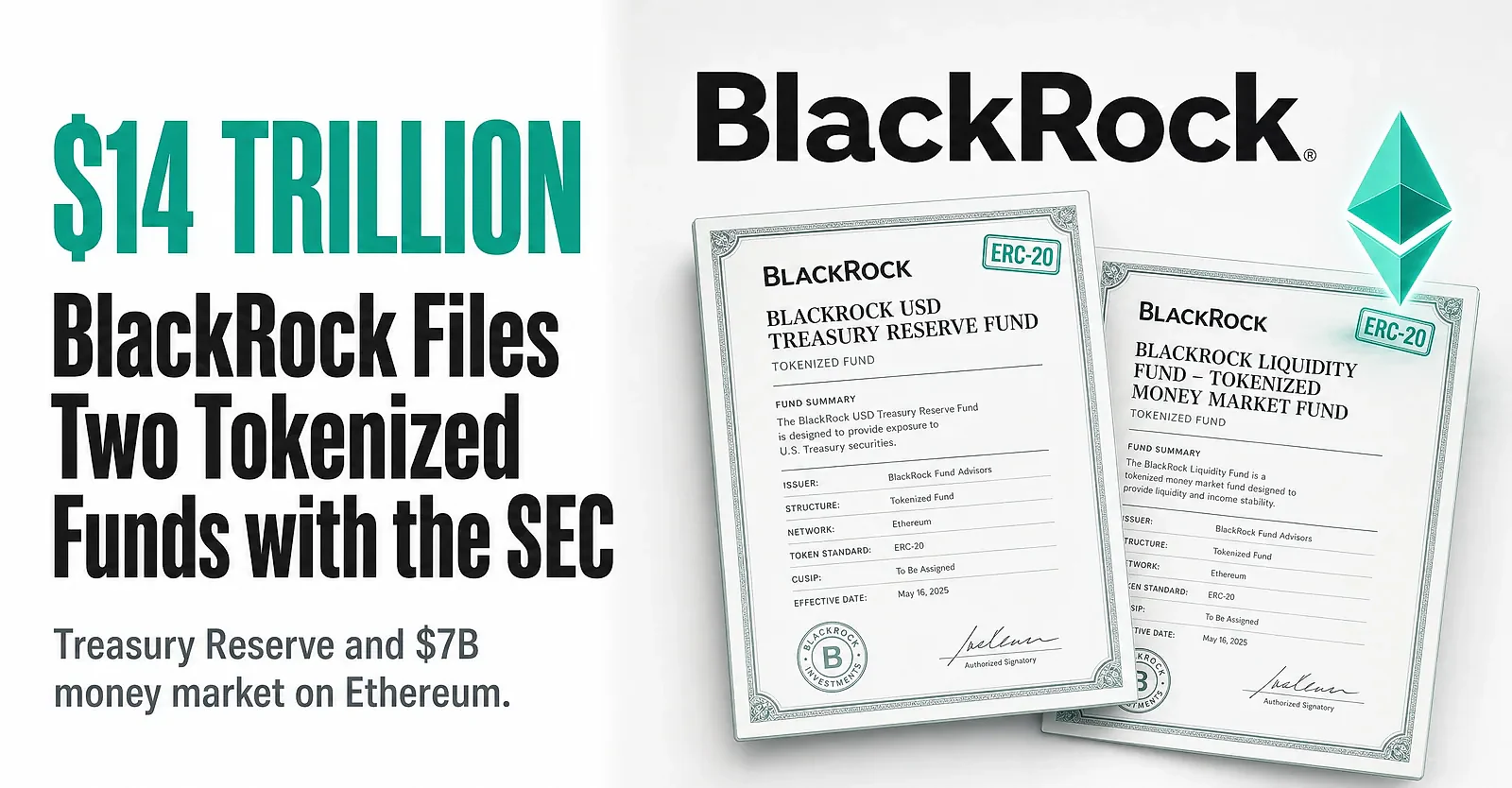
BlackRock, the world's largest asset manager with more than $14 trillion in assets under management, filed two separate registration statements with the U.S. Securities and Exchange Commission on May 8-9, 2026, proposing new on-chain fund structures that would issue tokenized shares over public blockchain networks. The filings, which build directly on the firm's BUIDL precedent, represent the most concrete step yet by a bulge-bracket institution to move regulated fund infrastructure onto Ethereum rails.[1]
Two Funds, Two Architectures
The first proposed vehicle, described in the filing as the BlackRock Daily Reinvestment Stablecoin Reserve Vehicle, is a newly created fund rather than an extension of an existing product. It would hold a portfolio of cash, short-term U.S. Treasury securities, and overnight repurchase agreements collateralized by Treasuries, a structure familiar to money-market investors. The fund would issue what the filing terms "OnChain Shares" through a permissioned system capable of connecting to multiple public blockchains. Securitize Transfer Agent LLC would serve as the official record-keeper, with off-chain identity systems linking verified investor wallet addresses to ownership records. The minimum investment threshold is set at $3 million.[1][2]
The second filing takes a different approach: rather than launching a brand-new fund, BlackRock proposes adding an on-chain share class to an already operating vehicle, the BlackRock Select Treasury Based Liquidity Fund (ticker: TFFXX), a 2a-7-compliant money-market fund carrying nearly $7 billion in assets under management. Under this structure, BNY Mellon Investment Servicing would record official shareholder information directly on the Ethereum blockchain using the ERC-20 token standard. Off-chain identity systems would link wallet addresses to investor records, preserving compliance with anti-money-laundering and know-your-customer requirements while making the fund's share register natively on-chain.[1][2]
Fund Comparison
Feature — Stablecoin Reserve Vehicle — Select Treasury Liquidity (TFFXX)
Structure — New fund — Existing fund, new share class
AUM — New launch — ~$7 billion
Underlying assets — Cash, short-term Treasuries, repo — 2a-7 money-market instruments
Blockchain — Multiple (TBD) — Ethereum
Token standard — OnChain Shares — ERC-20
Transfer agent — Securitize Transfer Agent LLC — BNY Mellon Investment Servicing
Minimum investment — $3 million — Not yet disclosed
Approx. yield — ~4% (accrued daily) — Money-market rate
BUIDL as the Foundation
Both filings trace their lineage to BUIDL, the BlackRock USD Institutional Digital Liquidity Fund, launched in March 2024 in partnership with Securitize. BUIDL began as an Ethereum-native private money-market fund with a $5 million entry threshold and has since grown to approximately $2.5 billion in assets, making it the largest tokenized Treasury fund globally.[1] The fund now operates across nine blockchain networks and functions as collateral in crypto lending and leveraged-trading protocols, demonstrating that institutional-grade tokenized yield products can achieve meaningful secondary utility beyond simple buy-and-hold.[2]
The May 2026 filings signal that BlackRock views BUIDL not as a one-off experiment but as a repeatable template. The Stablecoin Reserve Vehicle is widely seen as targeting the $200 billion-plus stablecoin reserve market, where issuers currently earn limited yield on underlying assets. A regulated, yield-bearing Treasury product accessible via blockchain rails could capture significant flows from stablecoin operators required under the GENIUS Act to hold reserves in U.S. Treasury obligations or 2a-7 money-market funds.[3]
What On-Chain Ownership Records Change
The practical implications of recording official ownership on Ethereum rather than in a legacy transfer agent's database are substantial. Settlement that currently takes one to two business days becomes near-instantaneous. Trading access extends to twenty-four hours a day, seven days a week, rather than being confined to market hours. Portfolio transparency increases because balances are visible on a public ledger. And programmability opens the door to automatic reinvestment, collateral pledging, and integration with decentralized lending protocols, without requiring investors to exit the regulated fund wrapper.[1][2]
Robbie Mitchnick, BlackRock's Head of Digital Assets, has articulated why this matters operationally:
"Tokenization has broken the paradigm that forced you to choose between capturing full yield on your U.S. dollar savings and having full liquidity."
The sentiment underpins both filings. The Stablecoin Reserve Vehicle targets yield-seekers currently holding non-yielding stablecoins, while the tokenized TFFXX share class offers institutional investors a path to hold a fully familiar 2a-7 instrument without the friction of traditional transfer and settlement systems.[4]
Institutional Tokenization Wave
BlackRock's move arrives as the broader tokenized real-world asset market has expanded more than 200% over the past twelve months to exceed $30 billion, according to RWA.xyz data, with the tokenized Treasury segment alone crossing $15 billion in early 2026.[1][3] A joint report from Boston Consulting Group and Ripple projects the tokenized RWA market could reach $18.9 trillion by 2033.[1]
The filings pair with parallel institutional infrastructure developments. The DTCC, which clears the overwhelming majority of U.S. equity and fixed-income trades, has advanced its own on-chain settlement pilots, and several primary dealers have begun accepting tokenized Treasuries as repo collateral. Together, these moves suggest that the tokenization of traditional financial instruments is transitioning from controlled pilots toward operational market infrastructure.
Larry Fink has framed the longer arc in a January 2026 interview: "If we could digitize every asset and have a more seamless way of going from a digital wallet of cash or a stablecoin into equities or bonds, it will reduce the friction cost and the transaction cost. The idea of tokenization of all assets is to just reduce huge friction costs and make investing easier and simpler."[5]
The two SEC filings are not yet approved; registration statements must go through review before shares can be offered to investors. The filing did not specify a timeline for launch.
References
[1] CoinMarketCap, "BlackRock Files for 2 New Tokenized Treasury Funds With SEC," May 11, 2026. https://coinmarketcap.com/academy/article/blackrock-files-tokenized-treasury-funds-sec
[2] 51 Insights, "BlackRock's stablecoin loophole," May 11, 2026. https://www.51insights.xyz/p/blackrocks-stablecoin-loophole
[3] MEXC News, "Tokenized Treasuries Cross $7B as Institutions Move Real-World Assets On-Chain," April 10, 2026. https://www.mexc.com/news/1018849
[4] Securitize / LinkedIn, "BlackRock's Robbie Mitchnick on the silver bullet of tokenization," 2025. https://www.linkedin.com/posts/securitize_blackrocks-robbie-mitchnick-weighed-in-on-activity-7394026144779603968-jE7w
[5] Etherealize / X, "BlackRock CEO Larry Fink: Tokenization will change finance forever," January 23, 2026. https://x.com/Etherealize_io/status/2029648147811815650