Asset Managers Push Back on 20 Percent Cap for Tokenized Stablecoin Reserves
BlackRock filed a 17-page comment letter with the OCC on May 1, 2026, opposing a proposed 20 percent ceiling on tokenized reserve assets for stablecoin issuers, arguing the restriction is structurally arbitrary and disconnected from any meaningful measure of credit risk.
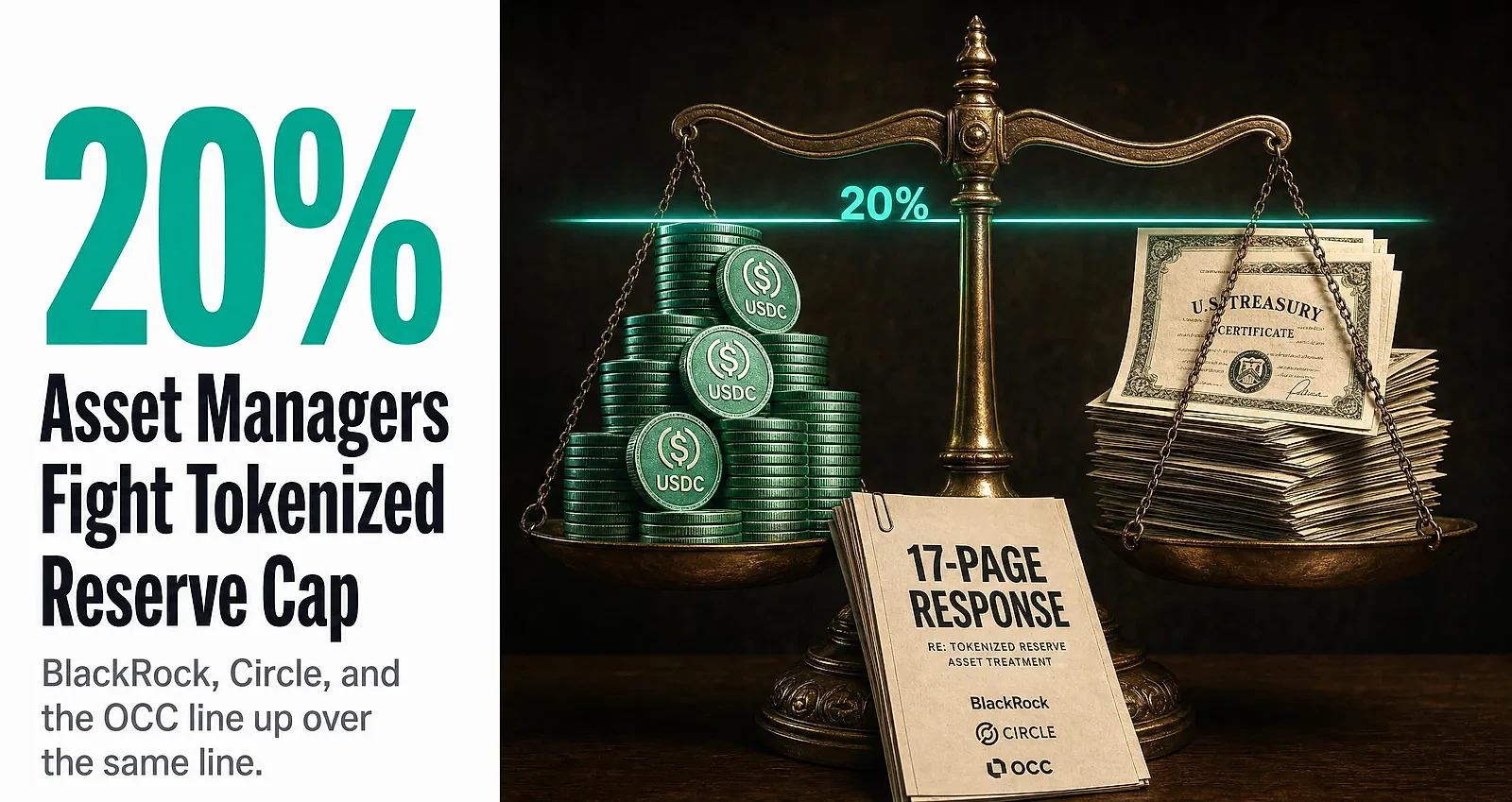
BlackRock submitted a 17-page formal comment letter to the Office of the Comptroller of the Currency (OCC) on May 1, 2026, the final day of the agency's 60-day public comment window, demanding the removal of a proposed 20 percent cap on tokenized reserve assets from draft rules implementing the GENIUS Act. The filing landed as one of more than 200 stakeholder responses the OCC must evaluate before finalizing rules that carry a January 2027 compliance deadline for all permitted payment stablecoin issuers.
The Regulation at Stake
The OCC's 376-page rulemaking proposal, published in the Federal Register on March 2, 2026, establishes the operational framework for a new regulatory category of federally chartered stablecoin issuers created by the Guiding and Establishing National Innovation for U.S. Stablecoins Act, enacted on July 18, 2025. Eligible reserve instruments under the proposal include U.S. cash, insured bank deposits, certain short-term Treasury notes, government money market funds, and tokenized versions of any of those instruments, to be housed in a new 12 CFR Part 15.[1]
Buried inside those provisions is a single quantitative threshold with outsized consequences: a binding ceiling that would prevent any permitted payment stablecoin issuer from holding more than 20 percent of its total reserve pool in tokenized form. For institutional asset managers that have built entire product lines around tokenized Treasury funds as reserve instruments, that threshold is a structural obstacle rather than a prudential safeguard.
BlackRock's Core Argument
BlackRock's letter characterizes the proposed ceiling as structurally unrelated to the OCC's own stated risk management objectives. The firm argues that reserve risk is determined by the credit quality, duration, and liquidity of the underlying instruments, not by whether those instruments are recorded and transferred on a distributed ledger.[2]
"The [limit is] unrelated to the [OCC's] objectives... risk profiles [are determined] by credit, duration and liquidity, not whether [an] asset is [held or] transferred [on] a distributed ledger."
The practical implication lands directly on BlackRock's BUIDL fund, the firm's tokenized money market vehicle issued through Securitize with nearly $2.6 billion in assets under management. BUIDL supplies more than 90 percent of the reserves backing Ethena's USDtb and Jupiter's JupUSD on Solana. A binding 20 percent ceiling would require those stablecoin issuers to fundamentally restructure their reserve portfolios, substituting non-tokenized instruments that offer no operational or transparency advantage over their on-chain equivalents.[3]
Beyond opposing the cap itself, BlackRock made three supplementary requests. First, the firm asked the OCC to confirm explicitly that Treasury ETFs investing solely in eligible assets qualify as reserves under Section 4 of the GENIUS Act, granting them parity with government money market funds. Second, BlackRock asked the agency to add U.S. Treasury floating-rate notes with up to two years of remaining maturity to the eligible reserve list. Third, and most broadly, BlackRock endorsed "Option A" in the OCC's reserve diversification framework, a principles-based approach with optional quantitative safe harbors, over "Option B," which would impose mandatory daily concentration limits and a 20-day weighted average maturity constraint across all issuers.[2]
USDC and the Broader Reserve Ecosystem
Circle's USDC is the stablecoin most structurally exposed to the 20 percent ceiling among large issuers, even though Circle's direct tokenized reserve holdings are minimal today. Circle Reserve Fund, a Rule 2a-7 government money market fund managed by BlackRock Advisors and custodied at BNY Mellon, holds approximately 80 percent of USDC reserves in short-dated Treasury bills and repos, with the remaining 20 percent in cash at regulated U.S. banks as of Q1 2026.[4] As institutional liquidity funds migrate toward tokenized formats, that reserve structure is a natural conversion candidate. A 20 percent cap would arrest that migration before it begins.
Circle's USYC tokenized Treasury fund, currently the largest in the segment at $2.9 billion in AUM, sits on the supply side of the same equation. USYC and BUIDL together represent roughly one-third of a tokenized Treasury market that surpassed $10 billion in aggregate value. Any regulatory constraint on the share of stablecoin reserves those funds can satisfy simultaneously constrains the growth runway for the tokenized Treasury segment itself.[3]
Stakeholder Landscape
The following table maps the key participants in the reserve cap debate and their positions:
Stakeholder — Role — Position on 20% Cap — AUM / Supply Affected
BlackRock (BUIDL) — Tokenized Treasury fund issuer — Opposes: seeks full elimination — ~$2.6B AUM
Circle (USYC) — Tokenized Treasury fund issuer — Opposed: supply-side constraint — ~$2.9B AUM
Circle (USDC) — Stablecoin issuer — Most exposed large issuer — ~$78B circulating supply
Ethena (USDtb) — Stablecoin issuer — Over 90% reserves in BUIDL — Existential restructuring risk
Jupiter (JupUSD) — Stablecoin issuer — Over 90% reserves in BUIDL — Existential restructuring risk
OCC — Federal regulator — Proposed the cap for rulemaking — Evaluating 200+ responses
Tether (USDT) — Stablecoin issuer — Less exposed (traditional mix) — ~$190B circulating supply
Connecting to the Wider Tokenization Build-Out
The OCC rulemaking does not exist in isolation. DTCC, the central clearing infrastructure for U.S. securities, has enrolled more than 50 firms in real-world asset tokenization services over the past twelve months, providing the settlement rails that institutional tokenized Treasury funds depend on for post-trade processing.[1] BlackRock's own registration of tokenized fund vehicles in parallel SEC filings signals that the supply-side infrastructure for tokenized reserves is already operational at institutional scale. A 20 percent ceiling applied at the stablecoin reserve layer would suppress demand for products whose distribution and settlement pipelines are otherwise complete.
The OCC's final rule is one of five parallel rulemakings: the FDIC, Treasury, FinCEN, and OFAC are each running independent processes, all converging on the January 2027 compliance deadline. BlackRock's letter explicitly does not address the implications of the other four. Each could impose independent reserve constraints that compound the effect of the OCC ceiling, or that resolve in a more permissive direction. The industry's formal comment record is now set; what the OCC does with it will define the economics of institutional stablecoin reserves for the next regulatory cycle.
References
[1] BYDFi CoinTalk, "Tokenization News May 2026: Infrastructure Analysis," May 6, 2026. https://www.bydfi.com/en/cointalk/tokenization-news-may-2026-infrastructure-analysis
[2] Bloomingbit, "BlackRock Urges OCC to Drop 20% Cap on Tokenized Assets," May 3, 2026. https://en.bloomingbit.io/feed/news/111267
[3] Tokenizer.Estate, "BlackRock asks OCC to drop 20% cap on tokenised reserves," May 4, 2026. https://news.tokenizer.estate/blackrock-asks-occ-to-eliminate-20-cap-on-tokenised-stablecoin-reserves/
[4] Eco Support, "USDC vs Tether: 2026 Comparison," April 23, 2026. https://eco.com/support/en/articles/11506245-usdc-vs-tether-2026-comparison
[5] CryptoNews, "BlackRock challenges OCC's 20% reserve cap for stablecoin issuers under GENIUS Act," May 3, 2026. https://cryptonews.net/news/finance/32801043/